
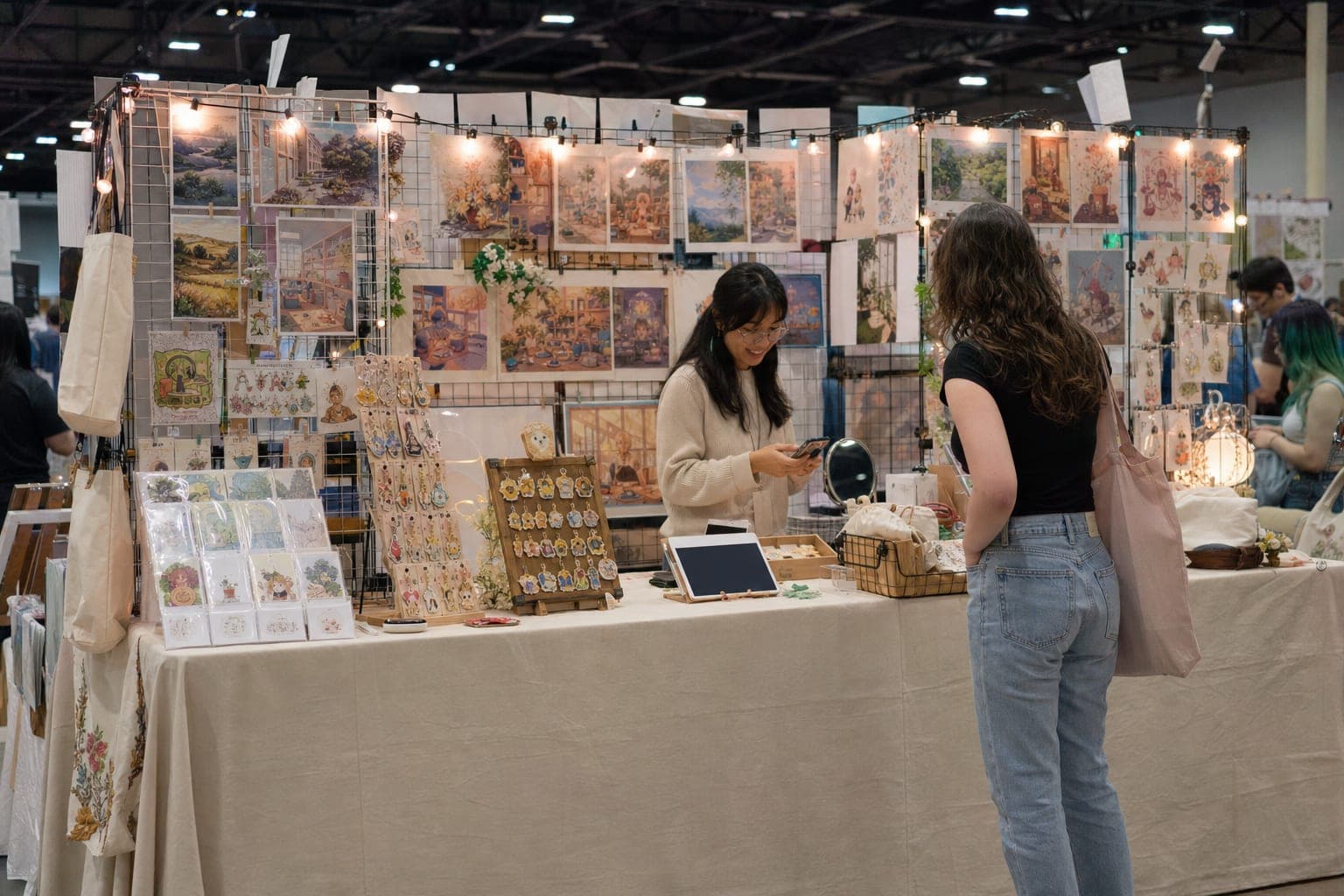
Craft show booth setup is the difference between a table people walk past and a booth people walk into — and almost all of it comes down to decisions you make before you ever leave the house. This guide walks you through the whole thing: how to plan a 10x10 footprint, size your tables and coverings, build vertical display so you escape the flat-table look, lay out traffic flow that pulls shoppers in, price and light everything so it reads from the aisle, weight an outdoor canopy so it survives wind, and build a checkout zone that doesn't jam up when three people want to buy at once. If you read nothing else: your booth is a 100-square-foot retail store, you have about three seconds to earn a stop, and the vendors who win are the ones who planned the layout on paper before setup morning.
Most first-time vendors do the opposite. They grab a folding table, a bedsheet, and a Sharpie, show up an hour before doors, and improvise. It sort of works — and it also quietly costs them sales all day, because a flat table at waist height with unpriced product and no lighting is exactly what shoppers have trained themselves to skip. The fix isn't more money. It's a plan.
The 10x10 Footprint: What You Actually Get and How to Plan It
The standard vendor booth is 10x10 feet — 100 square feet — and that is the single most important number in this whole guide. Many shows also sell 10x20 doubles and 10x5 half-booths, but the 10x10 is the default you should design around. That 100 square feet has to hold your display, your inventory, your checkout, and you — and it fills up faster than anyone expects.
Before you buy a single thing, draw the square to scale on paper (or in any free floor-plan app) and place everything inside it:
- Your display footprint — tables and vertical fixtures usually eat the back and one or both sides.
- Customer standing room — the open area shoppers actually stand in. Protect it.
- Your workspace — where you stand, ring people up, and reach restock.
- Hidden storage — bins of backstock have to live somewhere, ideally under a floor-length tablecloth.
A common rookie mistake is filling all four sides with tables, which boxes shoppers out and leaves you no room to move. If you are still choosing gear to fill that square, our craft show tent buying guide breaks down frames, denier, and weight systems by budget. For your very first event, the pop-up shop and craft show packing checklist covers everything that has to physically make it into the car.
Draw your 10x10 to scale before setup morning. Ten minutes with a pen saves you from the "everything's already unpacked and now it doesn't fit" panic that eats your first hour on-site.
Tables and Coverings: Sizing, Floor-Length Cloths, and Hidden Storage
Two 6-foot folding tables (or one 6-foot plus one 4-foot) is the workhorse configuration for a 10x10. The detail that separates an amateur booth from a professional one is almost embarrassingly simple: floor-length tablecloths.
A cloth that drops all the way to the ground does three jobs at once. It hides the ugly folding-table legs, it turns the space underneath into concealed storage for restock bins and your bag, and it reads instantly as "real shop" instead of "garage sale." Craft Professional's craft show setup guide makes the same point — the floor-length cloth is the highest-leverage, lowest-cost upgrade you can make.
A few sizing and material notes:
- Measure table height plus a full drop to the floor on all exposed sides before buying cloths.
- Weighted or clipped cloths beat loose ones outdoors — wind will lift them and expose the mess.
- Keep restock bins labeled and stacked by SKU under the table so you can refill without turning your back to the aisle for long.
Vertical Display: Grid Walls, Shelving, and Backdrops to Escape the Flat Table
Here is the shift that changes everything: stop selling off a flat table and start selling up a wall. A flat table caps your display at waist height and forces shoppers to look down. Vertical fixtures — grid walls, slatwall panels, shelving, ladder displays, backdrops — put product at eye level where people actually browse.
Aim to merchandise your best-selling, mid-range items around 50 to 60 inches from the floor, which is roughly adult eye level. Small impulse items go lower, in the 36-to-48-inch easy-reach zone near the front. Vertical display also frees up table space, so your surfaces stop looking cluttered.
For a deeper menu of fixtures and arrangements, see our booth display ideas that drive sales. If you sell smaller flat goods like prints, pins, or charms, the acrylic charms and enamel pins guide for artist alley covers pegboard, rack, and hanging setups made for that product type.
Don't Over-Pack the Wall: Density and Restock Rhythm
More product on the fixture is not more sales. A wall crammed edge to edge reads as chaos, and shoppers can't lock onto anything, so they lock onto nothing and move on. Give your hero pieces breathing room — negative space around a piece makes it look more valuable, not less. A practical rule: fill the fixture to about two-thirds visual density and keep the rest of your stock in labeled bins under the table.
That also sets your restock rhythm. When a peg or shelf empties, refill it from the bin the moment there's a lull — an obviously picked-over display signals "leftovers" even when your backstock is deep. Restocking from underneath the floor-length cloth means you never leave the booth or turn your back to the aisle for more than a few seconds.
Booth Layout and Traffic Flow: U-Shape, L-Shape, and Keeping Aisles Clear
How you arrange those tables inside the square determines whether people flow through your booth or drift past its edge. The two proven craft fair booth layouts are the U-shape and the L-shape.
| Layout | How it's arranged | Best for | Watch out for |
|---|---|---|---|
| U-shape | Tables on three sides, open front | Immersive browsing, higher engagement, more display surface | Only one shopper zone; can feel crowded; you're partly boxed in |
| L-shape | Tables on the back and one side | Easy solo management, clear sightlines, faster checkout | Slightly less display real estate |
| Straight line | One row across the front | Dead simple, fast setup | Reads as a barrier; shoppers stay in the aisle and don't enter |
The U- and L-shapes both pull shoppers in off the aisle, which is the entire goal — a straight table across the front acts as a wall that keeps them out. Whichever you choose, keep the interior aisle clear of boxes, bags, and cords so people can move and, critically, so you stay code-compliant (more on that below).
Signage and Pricing Visibility: Price Every Item and Make the Sign Readable
Two rules, and they are not optional. Price every single item, and make your booth name sign readable from across the aisle.
Unpriced product is the silent killer of craft show sales. A large share of shoppers will simply not ask "how much?" — they assume it's expensive, or they don't want the awkward conversation, so they put it down and move on. Made Urban's rundown of craft show pricing psychology covers why clear pricing matters and a few tactics worth stealing:
- Charm/odd pricing — $7, $17, $27 reads as more honest and considered than round numbers.
- Price anchoring — the first price a shopper sees frames everything after it, so lead with a hero piece.
- Eye-level bestsellers — put your mid-range, high-volume items at the front at eye level.
For your business name, banner, and per-product signs, our craft show signage guide spells out exactly what belongs on every sign and how big the text needs to be.
Booth Lighting: Powered vs. Battery LED and How Many Watts a 10x10 Needs
Lighting is the upgrade most vendors skip and then regret the first time they set up in a dim convention hall or under a tent canopy. As a target, roughly 1,000 watts fully lights a 10x10 booth, though plenty of vendors get by on about 500 watts of well-placed light. Handmade Business's booth lighting guide is a solid primer on fixtures and placement.
Your setup depends on whether power is supplied:
| Power situation | Recommended lighting | Notes |
|---|---|---|
| Venue supplies an outlet | Plug-in LED spots/bars, ~500–1,000W equivalent | Confirm whether power costs extra; many shows charge for it |
| No power supplied | Battery + inverter running LED strips/panels | LED sips power; size the battery to your show hours |
| Outdoor daytime | Often none, but shade + fill light helps | Avoid hot halogen/metal-halide — banned at many venues |
Two hard rules: use LED, not hot halogen or metal-halide fixtures (many venues ban them outright for the burn and fire risk), and if you're running off a battery, test the full run-time at home before you count on it lasting a show day.
Power and Extension Cords: Cord Management, Runners, and Fire-Code Basics
If you're running power, cords become a safety issue the fire marshal genuinely cares about. Loose cords across an aisle are a trip hazard and a code violation. The basics:
- Run cords along the back and edges of your booth, never straight across a customer aisle.
- Use gaffer tape or a rubber cord runner to secure any cord that must cross a walkway.
- Bring your own grounded, rated extension cords and a power strip — assume the venue provides nothing.
- Keep cords clear of your booth's exit opening, which must stay a minimum of 3 feet wide.
Fire and life-safety rules exist for a reason and inspectors do walk booths. The U.S. National Park Service's fire and life-safety requirements for outdoor events and tents is a clear public reference for the codes most permitted events follow.
The aisle and exit rules you actually need to know
- Aisle width: at least 44 inches for occupant loads over 50 people, and 36 inches for 49 or fewer.
- ADA accessible route: the U.S. Access Board's ADA standards require a 36-inch minimum clear width so wheelchairs can pass — a good baseline for every booth.
- Exit opening: keep your booth's exit a minimum of 3 feet wide and clear of tables, boxes, and cords.
- Fire extinguisher: assembly tents generally need at least a 2A:10-BC extinguisher within 75 feet; add a Class K within 30 feet if you cook.
- Flame resistance: tent and canopy fabric must carry an NFPA 701 flame-resistance label at most permitted events, typically valid for one year.
Weights and Wind for Outdoor Booths: Pounds Per Leg, Stakes, and Sidewalls
Outdoor shows add one non-negotiable: weight every canopy leg. A pop-up canopy is a sail. A gust can flip it, and a flying tent is dangerous and expensive.
The working numbers from Instent's canopy weight guide:
| Surface / condition | Weight per leg | Total (10x10) |
|---|---|---|
| Minimum, sheltered site | ~40 lb | ~160 lb |
| Exposed or windy site | ~50 lb | ~200 lb |
| Concrete (can't stake) | ~50 lb | ~200 lb |
You don't have to spend a fortune. A full 5-gallon water jug weighs about 41 pounds — one per leg hits the minimum. Or build DIY PVC-and-concrete weights for roughly $40–$60 for a set of four. On soil, a proper staking kit adds real hold; many canopies are wind-certified to around 35 mph only when staked into the ground. Add sidewalls on exposed sites — they block wind-driven rain and low sun, and they double as overnight security at multi-day shows.
Weight your legs the moment the canopy goes up — before you unpack a single product. Most airborne-tent incidents happen during the unweighted setup window, not during the show.
Building a Fast Checkout Zone Inside the Booth
A slow checkout is a sales cap. When a line forms, browsers who would have bought see the wait and leave. Your craft show booth setup should carve out a dedicated checkout zone — usually one corner or the L-shape's short leg — with:
- A clear, waist-height surface for bagging and card-tapping.
- Your payment device mounted or propped so both hands stay free.
- Bags, tissue, and receipts within arm's reach so you're not hunting.
- A backup power bank so a dead phone never stops a sale.
This is where a booth app earns its keep. Shipyie runs an order kiosk or QR-code checkout on the phone or tablet you already own, syncs Square POS sales, and works offline when the convention Wi-Fi dies — so line-jamming and dropped connections stop costing you sales. It's honest about its lane: it is not a payment processor and not POS hardware; it integrates Square for the actual charge and runs on your own device. For layout and flow ideas that shave seconds off every transaction, see our guide on speeding up convention booth checkout.
Your Load-In and Tear-Down Kit: The Setup Toolkit That Saves the Show
The vendors who set up calm and fast all carry the same boring box of gear. Build yours once and it lives in the car:
- Gaffer/gorilla tape, zip ties, and bungee cords
- Scissors, a box cutter, and a Sharpie multipack
- Clamps and binder clips (for signs, cloths, and banners)
- A cordless drill or ratchet if your fixtures need assembly
- Extra price tags, blank signs, and a small first-aid kit
- Wet wipes, trash bags, and a folding stool
Setup Morning Timeline
Give yourself margin. A rushed setup shows in the finished booth.
- Arrive early and confirm your space number and orientation.
- Frame first — pop the canopy and, outdoors, weight every leg immediately.
- Tables and cloths — set your U or L, then drape floor-length cloths.
- Vertical fixtures — grid walls, shelving, and backdrop go up next.
- Merchandise — bestsellers at eye level, impulse items up front and low.
- Signage and prices — banner readable from the aisle, every item priced.
- Lighting and power — cords taped down and clear of the aisle and exit.
- Checkout zone — device charged, bags stocked, backup battery ready.
- Walk the aisle — stand where a shopper stands and fix what looks off.
The Bottom Line
A great craft show booth setup is 90% planning and 10% gear. Draw your 10x10 to scale, build up with vertical display instead of out across a flat table, choose a U- or L-shape that pulls shoppers in, price and light everything so it reads from the aisle, and — outdoors — weight every leg before you touch a product. Respect the aisle, exit, and fire-code minimums, because inspectors do check and a clear booth is a safer, more shoppable booth. Then protect your sales at the finish line with a checkout zone that stays fast even when the line is deep and the Wi-Fi is bad. Do those things and you've turned 100 square feet into a store that earns the stop.