
Before the Show: Planning and Prep
You will forget something at your first craft show. Everyone does. The question is whether it will be something minor — like an extra pen — or something that tanks your entire day, like your card reader charger dying at 11 a.m. with six hours left on the clock.
This checklist exists so that the thing you forget is small and survivable. We have organized every item by category, included specific costs where they matter, and flagged the mistakes that quietly cost first-time vendors hundreds of dollars in lost sales.
Print this out. Tape it to the inside of your supply bin. You will thank yourself at 6 a.m. on event morning.
Your booth fee is paid, your products are made, and the event is next weekend. Here is what to lock down before you load the car.
Know Your Numbers
Booth fees range from free at community markets up to $250 for established craft fairs and $500–$1,000 at large festivals. Before you commit, calculate your break-even point. If your booth costs $150 and your average item sells for $25, you need six sales just to cover the table — before materials, gas, and your time.
Set Your Price Tiers
A focused product range in two to three price tiers consistently outperforms a wide assortment. Structure your inventory around these proven price points:
| Tier | Price Range | Purpose |
|---|---|---|
| Impulse | Under $5 | Gets wallets open, low commitment |
| Mid-range | $15–$35 | Your bread and butter, highest margin sweet spot |
| Premium | $50+ | Anchor pieces that make mid-range feel affordable |
Most of your revenue will come from that $15–$35 mid-range. Stock accordingly.
Prepare Your Cash Box
Bring a separate cash box with dedicated change — never mix personal and vendor cash. Start with at least $50–$75 in small bills and coins: fifteen ones, two fives, and $10 in quarters. You do not want your first customer handing you a $20 for a $7 item while you scramble through your wallet.
Display and Setup Essentials
Your booth is your storefront. Customers decide whether to stop or keep walking in about three seconds.
The Non-Negotiable Setup Kit
- Pop-up tent (10x10 is standard) — Budget $200–$350 for a decent one. Amortized over roughly 60 events across a five-year lifespan, that works out to about $5 per show. Worth every cent for shade and rain protection.
- Tent weights: 25–40 lbs per leg. This is not optional. An unweighted tent in a gust becomes a projectile. Sandbags, water weights, or concrete-filled PVC all work. Do not rely on stakes alone — many venues have asphalt or concrete surfaces where stakes cannot anchor.
- Tables and tablecloths — At minimum one six-foot table with a cloth that reaches the floor on three sides (hides your storage bins underneath).
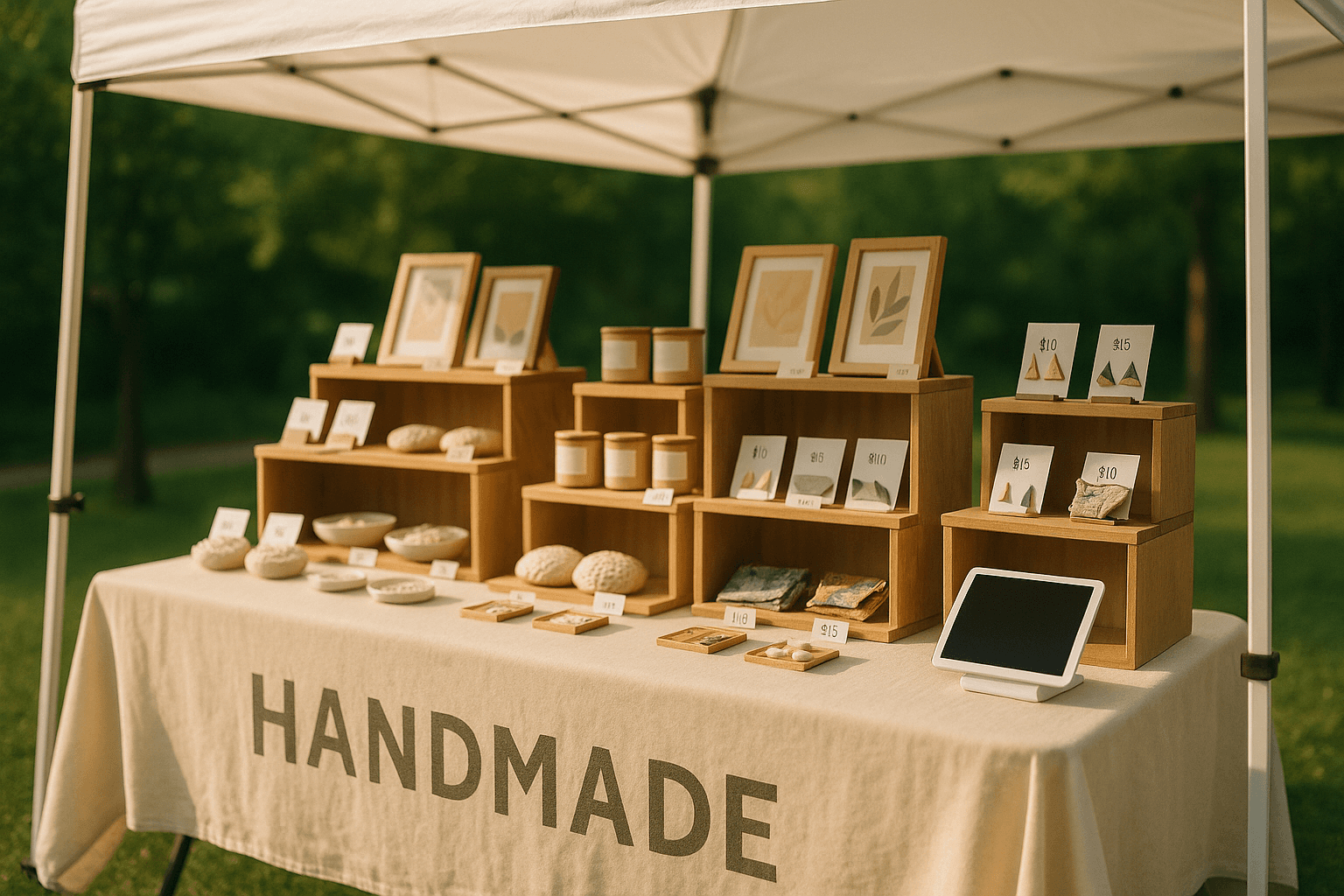
- Risers, crates, or shelving — Products at multiple heights draw the eye. A flat table is a boring table.
- Extension cord and power strip — Even if you think you will not need power, bring a 25-foot outdoor-rated extension cord. You will need it for your phone charger at minimum.
Price Everything Visibly
This is the single highest-impact thing you can do, and vendors consistently underestimate it. Customers will not ask "how much?" — they walk away. Every single item needs a visible price. Use price tags, small signs, or a clear price list displayed at eye level.
No price tag means no sale. Period.
Signage Checklist
- Business name banner or sign (readable from 10+ feet)
- Price signs for each product category
- Payment methods accepted sign ("Cash, Card, Tap")
- Social media handles or QR code for your shop
- Any "made locally" or material callouts that differentiate your products
Bring extra signage materials — blank card stock, a thick marker, and tape. You will want to make at least one sign on the spot.
Sales and Payment
Here is where most first-timers leave real money on the table.
Accept Every Payment Method
Going cash-only feels simpler, but it costs you more in lost sales than processing fees ever will. Square charges 2.6% + $0.10 per tap or dip. On a $25 sale, that is $0.75. You will lose far more than $0.75 by turning away the customer who only carries a debit card.
Bring your card reader AND a backup charging cable. A dead card reader mid-event is one of the most commonly cited disasters among first-time vendors.
Your Sales Station Kit
- Card reader (charged) + charging cable
- Cash box with pre-sorted change
- Calculator or phone calculator app
- Receipt paper or digital receipt option
- Bags for customers (paper or branded if possible) — this is the most frequently forgotten item
- Scissors and tape for wrapping or packaging
- Business cards
Capture Contact Info From the 90% Who Do Not Buy
Here is a number that reshapes how you think about events: roughly 90% of craft show visitors will not buy from any individual booth. That is not a failure — that is normal foot traffic. But if you have no mechanism to capture their contact info, you lose that 90% permanently.
An email signup sheet works. A fishbowl business card raffle works. But the most effective approach is giving visitors a reason to scan something — a QR code linking to your product catalog, an ordering page, or a giveaway entry. They engage on their own phone, on their own time, and you get a real contact.
This is where tools like Shipyie earn their keep. Instead of hoping someone remembers your booth name two days later, a QR-code-based ordering page lets customers browse your full catalog, place orders on the spot (even if your Wi-Fi is unreliable — Shipyie works offline), and you walk away from the event with actual customer data instead of a vague hope that foot traffic converts later.
Comfort and Survival
You are going to be standing, sitting, and talking for 6–10 hours. Do not neglect yourself.
Personal Essentials
- Water and snacks — Pack more than you think you need. Event food is overpriced and lines are long.
- Comfortable shoes — You will be on your feet on concrete or grass. Wear shoes you have already broken in.
- Sunscreen and hat (outdoor events)
- Layers — Morning setup is cold, midday is hot, and indoor venues blast unpredictable AC.
- Phone charger or portable battery pack — Your phone is your calculator, payment processor, and camera. Do not let it die.
- Folding chair — One that fits behind your table. Stand to greet, sit to rest.
- Hand sanitizer and basic first aid — Blisters, paper cuts, and headaches happen.
Emergency Repair Kit
Zip ties, duct tape, binder clips, extra tent stakes, a multi-tool, and a few garbage bags. Something will break or blow over. You want to fix it in two minutes, not lose an hour.
The Printable Checklist
Cut this out and keep it in your event bin.
| Category | Item |
|---|---|
| Setup | Pop-up tent (10x10) |
| Setup | Tent weights (25-40 lbs per leg) |
| Setup | Tables + tablecloths |
| Setup | Risers and display shelving |
| Setup | Extension cord + power strip |
| Setup | Scissors, tape, zip ties, duct tape |
| Signage | Business name banner |
| Signage | Price tags on every item |
| Signage | Payment methods sign |
| Signage | QR code sign and social handles |
| Signage | Blank card stock + marker (backup signs) |
| Sales | Card reader (charged) + backup cable |
| Sales | Cash box with $50-$75 change |
| Sales | Customer bags |
| Sales | Business cards |
| Sales | Contact capture method (signup sheet, QR code, or digital ordering tool) |
| Product | Inventory (organized by price tier) |
| Product | Extra stock in labeled bins |
| Product | Packaging and wrapping materials |
| Comfort | Water + snacks |
| Comfort | Sunscreen + hat |
| Comfort | Layers and rain jacket |
| Comfort | Folding chair |
| Comfort | Phone charger and battery pack |
| Comfort | Hand sanitizer + first aid |
| Emergency | Multi-tool |
| Emergency | Garbage bags |
| Emergency | Extra tent stakes + binder clips |
Your First Event Will Not Be Perfect
Accept that now. Your display will look different than you imagined. You will price something wrong. You will wish you brought one more table. That is all fine.
The vendors who build sustainable businesses are the ones who treat every event as a data collection exercise. Track what sold, what got attention but did not sell, what questions people asked, and which price points moved fastest. Bring a notebook or use your phone to jot observations during slow moments.
And the most important thing is that you show up prepared, stay organized, and learn from every single event. See you at the booth.