
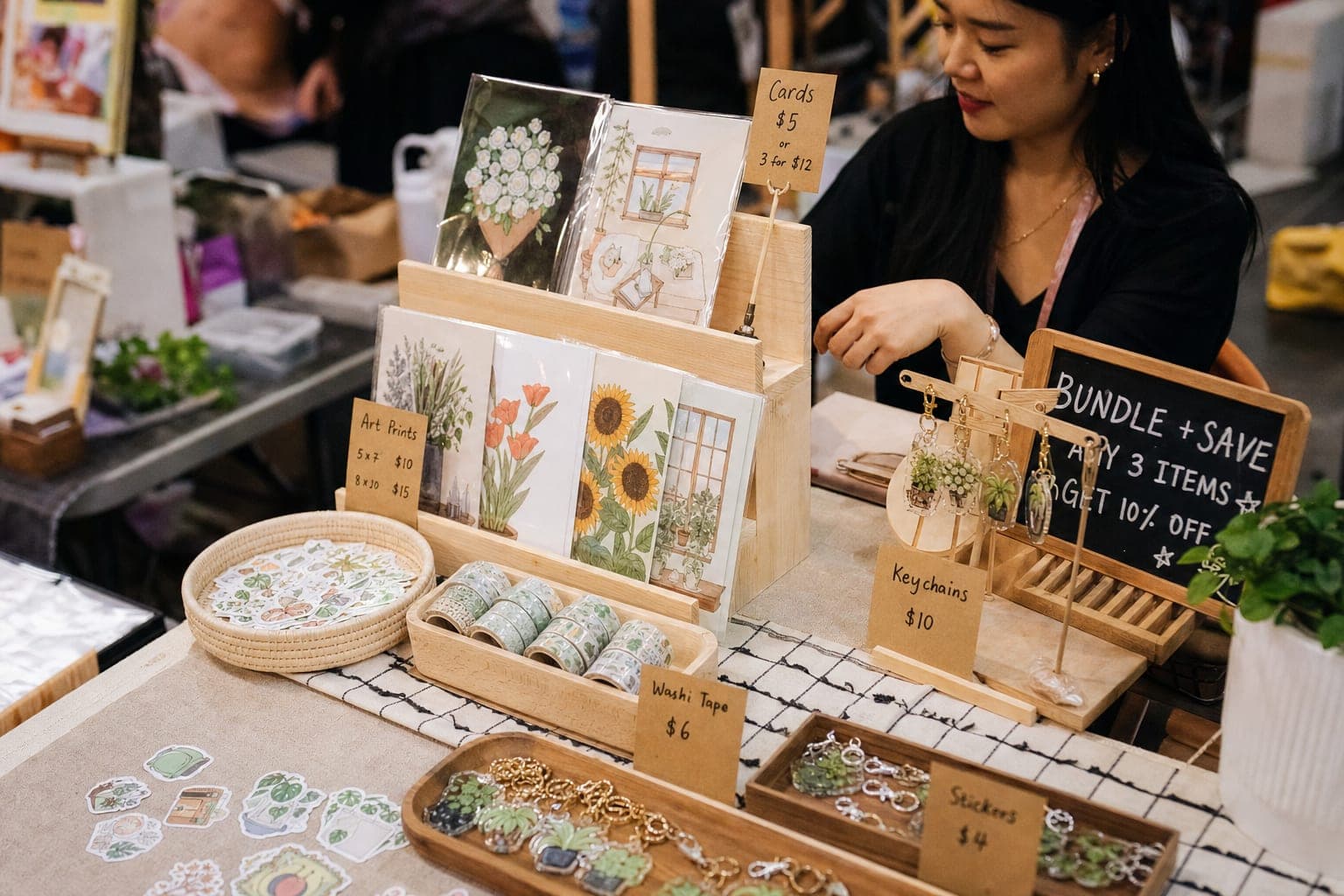
Craft fair price tags are the quietest salesperson at your booth, and a missing or messy one costs you sales you never see. A large share of shoppers will not stop to ask "how much?" — they glance, see no price, and keep walking, so every item needs a clear tag or a sign covering it. This guide covers the formats that work, the font sizes that read at a distance, the pricing psychology that actually moves goods at a cash-heavy booth, the materials that survive a windy outdoor show, and copy templates you can steal today.
Why a Visible Price Tag Sells More Than Silence
Shoppers at a craft show make fast, low-stakes decisions while walking a crowded aisle. When an item has no visible price, most people assume it is either too expensive or too much hassle to ask about, and they move on rather than make eye contact and start a negotiation. Shopify's craft-fair guide is blunt about it: put a clear price tag or barcode label on "every single item" because it speeds checkout and cuts errors.
The unspoken math is simple. A tag does three jobs at once: it answers the buying question, it signals that you are a real business, and it removes the social friction of asking. Silence does the opposite on all three counts.
Rule of thumb: if a browser has to ask the price, you have already lost a chunk of would-be buyers. Price every item, every time — even the $5 impulse pieces.
For the wider money picture behind those tags, our pillar on craft vendor finances, pricing, profit, and taxes walks through margins and break-even, and how to price handmade items for craft shows covers arriving at the number that goes on the tag in the first place.
Price-Tag and Sign Formats That Work at a Booth
You need three layers of pricing signage, each doing a different job at a different distance:
- Individual price tags — one per item, for anything where the price varies by piece. Must be legible at 3-4 feet (the reach-and-touch zone). Minimum 18-24 pt bold font.
- Category / table signs — "All Mugs $28" or "Prints $15 each." These do the heavy lifting when many items share a price and save you tagging every single one. Must read at 6-10 feet (the aisle-scanning zone): 36 pt headline, 24 pt detail.
- A master price list / menu board — one framed card or chalkboard showing the full range so aisle-walkers can qualify themselves before they even stop.
Mixing formats is fine and expected; the mistake is having none. A common, clean setup is category signs for your bread-and-butter lines plus individual tags for one-off or premium pieces.
| Sign type | Read distance | Min font | Best for |
|---|---|---|---|
| Individual tag | 3-4 ft | 18-24 pt | Variable-priced or premium items |
| Category / table sign | 6-10 ft | 36 pt / 24 pt | Many items at one price |
| Master price list | 8-12 ft | 36 pt+ | Qualifying aisle traffic |
Keep the visual system tight: a maximum of two fonts and two to three brand colors across every tag and sign, always high-contrast (dark on light or light on dark). Skip light-gray-on-white and script fonts for the actual number — a bold sans-serif wins at distance every time. Our guide to craft show signage and what to put on every sign has the full hierarchy.
Pricing Psychology on the Tag: Round Numbers, Tiers, and a Premium Anchor
Charm pricing — the $X9 ending — is real. In a set of field experiments, an apparel item priced at $39 outsold the same item at $34, the classic left-digit effect. But that same research found 9-endings work best in low-information catalog retail and weaken when a "Sale" cue is present. At a cash-heavy craft booth where buyers decide in seconds and you make change by hand, clean round numbers usually win: price to endings of $5 or $0. A $25 tag reads faster than $24.99, and it makes change trivial. $12 beats $11.75. Save the psychology for the number, not for a penny you have to fish out of a coin bag.
The anchor effect is where the real leverage sits. In Dan Ariely's well-known Economist subscription test, adding a same-priced decoy pushed 84% of people to the premium bundle; removing it flipped 68% back to the cheap option. Applied to your table: put one deliberately high-priced "hero" piece out — the $180 statement quilt, the $95 large print — and your $28 mugs and $15 prints suddenly feel like the reasonable, sensible choice. People judge price by comparison, not in a vacuum.
Three tag tactics that convert:
- Round to $5/$0 so change is fast and the number reads clean.
- Anchor with one premium piece so your mid-tier looks like the smart buy.
- Spell out bundle savings — "3 for $30 (save $6)" beats an unexplained multi-buy every time.
Materials and Durability: Indoor vs. Outdoor
Your tag material should match the venue, and it barely dents your budget:
- Kraft string tags — about $5 for 100. Great for indoor tables and tagging-gun jobs.
- Tagging gun + barbs — makes per-item tags look retail-professional and speeds wholesale orders too.
- Acrylic table tents — roughly $8-15 each. Reusable, wipe-clean, ideal for category prices.
- Chalkboard labels — about $12 for a set of six reusable labels; rewrite prices per show.
- Coroplast / rigid signs — the outdoor pick. Weatherproof, won't curl, and won't sail off the table in wind.
- DIY wooden block signs — $3-5 each, warm look for a rustic booth.
Indoors, paper and acrylic are fine. Outdoors, go rigid and weighted — kraft tags flap, ink runs, and a gust turns your neat pricing into confetti. For layout inspiration that keeps prices visible without cluttering the table, see these convention booth display ideas that drive sales.
Copy Templates You Can Steal
Single-item tag
Hand-Thrown Mug — $28 Dishwasher safe · holds 12 oz
Bundle deal
Any 3 Prints — $30 (save $6) Mix & match, 5x7 size
Good / Better / Best tier card
Sticker $4 · Print $15 · Framed Print $45
Show-special sign
Show Weekend Only: Second Candle 30% Off
Notice each one states the deal and, where relevant, the saving. Vague "multi-buy discount" signs underperform because the shopper has to do the math; you do it for them.
Tax-Inclusive Round Pricing and Keeping Tags in Sync
One trick cash-heavy vendors love: bake sales tax into a round tag so a $25 tag means $25 out the door. It kills the "that'll be $27.19" fumble and keeps your line moving. You still have to track and remit the tax — for example, California issues a free temporary seller's permit for events of 90 days or less, and the tax is owed either way. So set your point-of-sale to record the tax portion even when the tag is tax-inclusive.
That is where tag-to-POS sync matters. If you run Square, each item carries a name, price, and description, so the number on the physical tag should match the item record exactly — no guessing at the register. Shipyie syncs Square sales into per-event P&L, so the round number on your tag ties back to what you actually netted after the show, not just what rang through — and if you sell to ship after the event, it batches USPS/UPS/FedEx labels so a $25 tag doesn't quietly become a $25-minus-postage loss.
Common Price-Tag Mistakes and How to Fix Them
- No price at all → tag or sign every item; browsers won't ask.
- Handwritten scrawl → print your tags or use a consistent marker and template.
- Font too small → hit the 18-24 pt (tags) and 36 pt (signs) minimums.
- Low contrast → bold dark-on-light or light-on-dark; ditch gray-on-white and script.
- Inconsistent formats → one font system, one color set, one rounding rule across the whole booth.
- Prices that don't match the register → sync every tag to your POS item record.
The Bottom Line
Good craft fair price tags do the selling you can't do while you're wrapping someone else's order. Price every item, size the font for the distance it's read at, round to clean $5/$0 numbers so change is fast, anchor your table with one premium piece, and spell out your bundle savings. Match the material to the venue, keep two fonts and a couple of colors, and make sure every tag matches your POS so checkout stays quick and your numbers stay honest. Nail those and your table starts converting browsers into buyers before you say a word.