
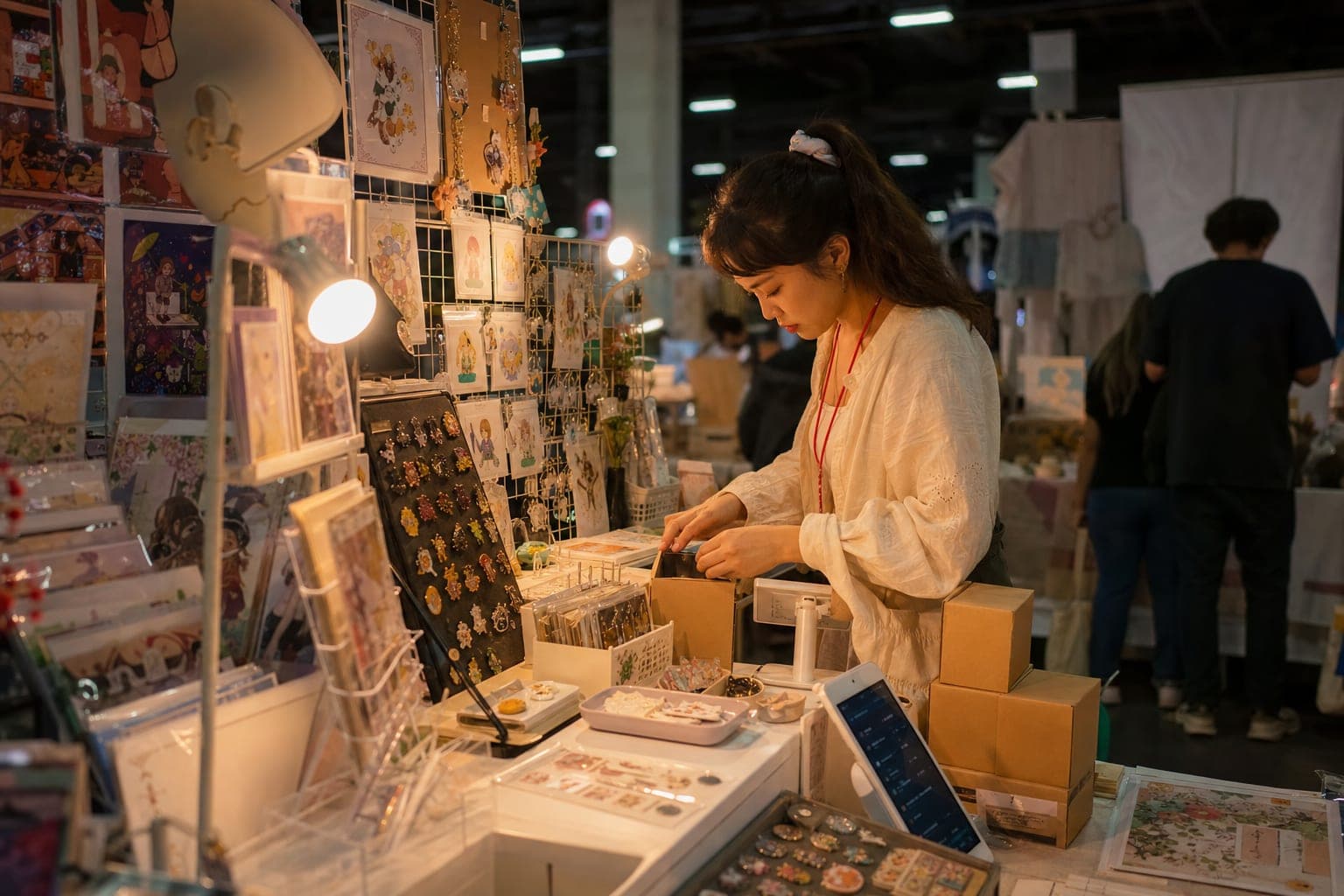
Craft show booth lighting is the cheapest upgrade that reliably pulls more foot traffic to your table and makes your handmade colors read true — and most vendors underspend on it while overspending on everything else. Under weak, wrong-colored light, a rich burgundy scarf looks like flat brown, walnut end-grain goes muddy, and shoppers drift past a table that looks dim next to the booth across the aisle. This guide covers color temperature, CRI, fixture types, battery vs plug-in power, the safety rules that actually matter, and a starter kit at three price tiers.
If you are still building out the rest of your table, read this alongside the full craft show booth setup guide — lighting is one layer of a system, not a standalone fix.
Why booth lighting matters more than you think
Two things happen when your lighting is good. First, your booth reads brighter than the ones around it, and human eyes drift toward light — you are literally buying attention for the price of a few clamp lamps. Second, and less obvious, your products look like what they actually are. Handmade buyers pay a premium for color, grain, and texture. If your light distorts those, you get fewer sales at the show and more "it looked different in person" regret later.
The spec that controls this is CRI (Color Rendering Index) — how faithfully a light source shows true color. Aim for 90+ CRI. Below CRI 80, colors shift and flatten: a warm burgundy reads as dull brown, and dyed or painted work loses the exact tone you priced it for. For color-sensitive handmade goods, high-CRI light is not a luxury spec — it is protecting the thing you sell. It is also usually printed right on the bulb box, so it costs nothing to check before you buy.
Color temperature: pick your Kelvin on purpose
Color temperature (measured in Kelvin) is the warmth or coolness of the light — a separate spec from CRI. Here is the practical map:
| Kelvin | Look | Good for |
|---|---|---|
| 2700–3000K | Warm, cozy, incandescent | Candles, wood, jewelry, cozy/rustic brands |
| 3500–4000K | Neutral | Most booths — safe middle ground |
| 4000–4500K | Neutral-cool, crisp | Bright prints, fabric, apparel where color accuracy matters |
| 5000K+ | Blue-white "daylight" | Rarely ideal — can look clinical on handmade goods |
Retail commonly lands in the 3500–4500K range to balance warmth with accurate product color (Revolve LED color-temperature comparison). Avoid harsh 6000K+ "headlight white" — it makes handmade goods look cold and cheap. One rule that saves regret: buy all your bulbs at the same Kelvin. Mixing warm and cool bulbs on one table looks accidental and amateur, even to a shopper who could not name why.
Quick test before you buy in bulk: order one or two bulbs, set them up at home over your actual products at night, and photograph them on your phone. If your reds, blues, and wood tones look right on camera, they will look right to a shopper's phone — which is where a lot of your booth photos and customer tags end up anyway.
Battery vs plug-in: the run-time math
The single biggest lighting decision is your power source, and it comes down to whether the venue gives you a real outlet.
Plug-in is simplest when power is included or cheap — but many shows charge $50–$150 for an outlet, and outdoor markets often have none. Battery power stations (portable lithium units) have become the vendor standard because they are silent, emit nothing, and work anywhere.
To size a battery, use this: usable hours = battery watt-hours ÷ total watts, then multiply by ~0.85 for inverter loss. A 1000Wh station running 100W of LED lighting lasts roughly 8–9 hours — a full show day. Typical clip/clamp LED work lights draw only 10–20W each, so four to six of them fit comfortably inside a 100–200W budget.
- Under 100W of lighting? A 500–1000Wh station covers one day.
- Two-day show? Recharge overnight, or size up to 1500Wh+.
- Running a card reader, phone charger, and lights off one battery? Add their draw into the total before you divide.
Generators: usually the wrong answer inside a tent
Some vendors reach for a gas generator. Be careful. Portable generators emit carbon monoxide and must run outdoors, well away from doors, windows, and vents, never in an enclosed or partly enclosed space (ESFI portable generator safety). Running one beside a closed tent is a genuine CO hazard, not a theoretical one. If you truly need engine power, an inverter generator is quieter and cleaner than a contractor unit (LED Trade Show Lights on craft-show power). But for most indoor and tent vendors, a silent battery station sized by the math above is simply the better and safer call.
Fixture types compared
You want ambient plus accent — a general wash so nothing sits in shadow, plus focused light on your hero pieces.
- Clip / clamp LED work lights — the workhorse. Clamp onto your tent frame or shelving, 10–20W each, cheap, aimable. Buy several.
- Track / spotlights — narrow beams that make a signature product glow. This is what separates a "lit" booth from a "designed" one.
- String / accent lights — warm ambiance and a cozy border, but they do not light products. Decoration, not illumination — don't count them as working lights.
- Tripod / floor lamps — good for tall side lighting when you cannot clamp to the frame.
LED is the standard across all of these because it runs cool and turns most of its energy into light — unlike halogen or metal halide, which waste most of their energy as heat and render color poorly. Inside a fabric tent, a hot halogen bulb is also a real burn and fire concern. Once your fixtures are placed, think about how the light interacts with your displays — the convention booth display ideas that drive sales piece covers height, layering, and focal points that your lighting should reinforce. And if you are still choosing the tent itself, the best craft show tents vendor buying guide covers frames sturdy enough to clamp lights to.
Power and safety: the non-negotiables
Electricity plus outdoor conditions plus extension cords is where vendors get hurt. A few rules:
- Use GFCI protection. OSHA requires ground-fault protection on non-permanent 120V outlets in use by workers, and explicitly rejects the "the floor is dry, so I'm fine" excuse — a safe grounding path cannot be assumed (OSHA GFCI interpretation). The end of an extension cord counts as a non-permanent receptacle. If the venue outlet is not GFCI-protected, use a portable GFCI adapter, especially outdoors.
- Inspect cords, retire damaged ones. Damaged or defective cords must be removed from service until repaired, and cords should not be hung or fastened in a way that chews up the jacket (OSHA 1910.334).
- Never plug or unplug with wet hands. Same OSHA rule. In rain, this matters.
- Use outdoor-rated cords and keep connections off wet ground.
- Tape down every cord across walkways — trip liability is real, and some shows require it.
A starter lighting kit at three price tiers
You do not need the pro setup on day one. Start where your budget is and upgrade as shows pay for it.
Budget (~$40–$80)
- 2–3 clip-on LED work lights, 90+ CRI, 3500–4000K
- A power bank or small station if there is no outlet
- A roll of gaffer tape for cords
Mid (~$150–$300)
- 4–6 clamp lights for full ambient coverage
- 1–2 small track spotlights for hero products
- A 500–1000Wh power station
- A portable GFCI adapter and outdoor-rated cords
Pro (~$400–$800+)
- Dedicated track lighting bar across the front of the booth
- Multiple aimable spotlights, all matched Kelvin
- A 1500Wh+ power station (multi-day capable)
- Warm string lights for ambiance on top of the working lights
Whichever tier you start at, treat lighting as a line item in your show budget, not an afterthought — and fold it into the same planning you do in the craft show booth setup guide. Once you can see whether a well-lit booth actually lifts sales, that becomes a per-event P&L question. Shipyie tracks revenue against each show's real costs, so you can tell whether the upgrade paid for itself instead of guessing.
The Bottom Line
Good craft show booth lighting is bright without being harsh, warm enough to feel inviting, and honest about color — which means 90+ CRI bulbs at a matched 3500–4500K, aimed at your best products. Power it with a silent battery station sized by simple watt-hour math, protect every outlet with GFCI, and keep gas generators far outside and away from tents. Start with a handful of clamp lights, add spotlights as you grow, and you will have a booth that stops people in the aisle for the price of a nice dinner.