
The Difference Between a Dead Booth and a Busy One
Two booths sit side by side at a convention. Same products. Same price range. Same foot traffic walking past.
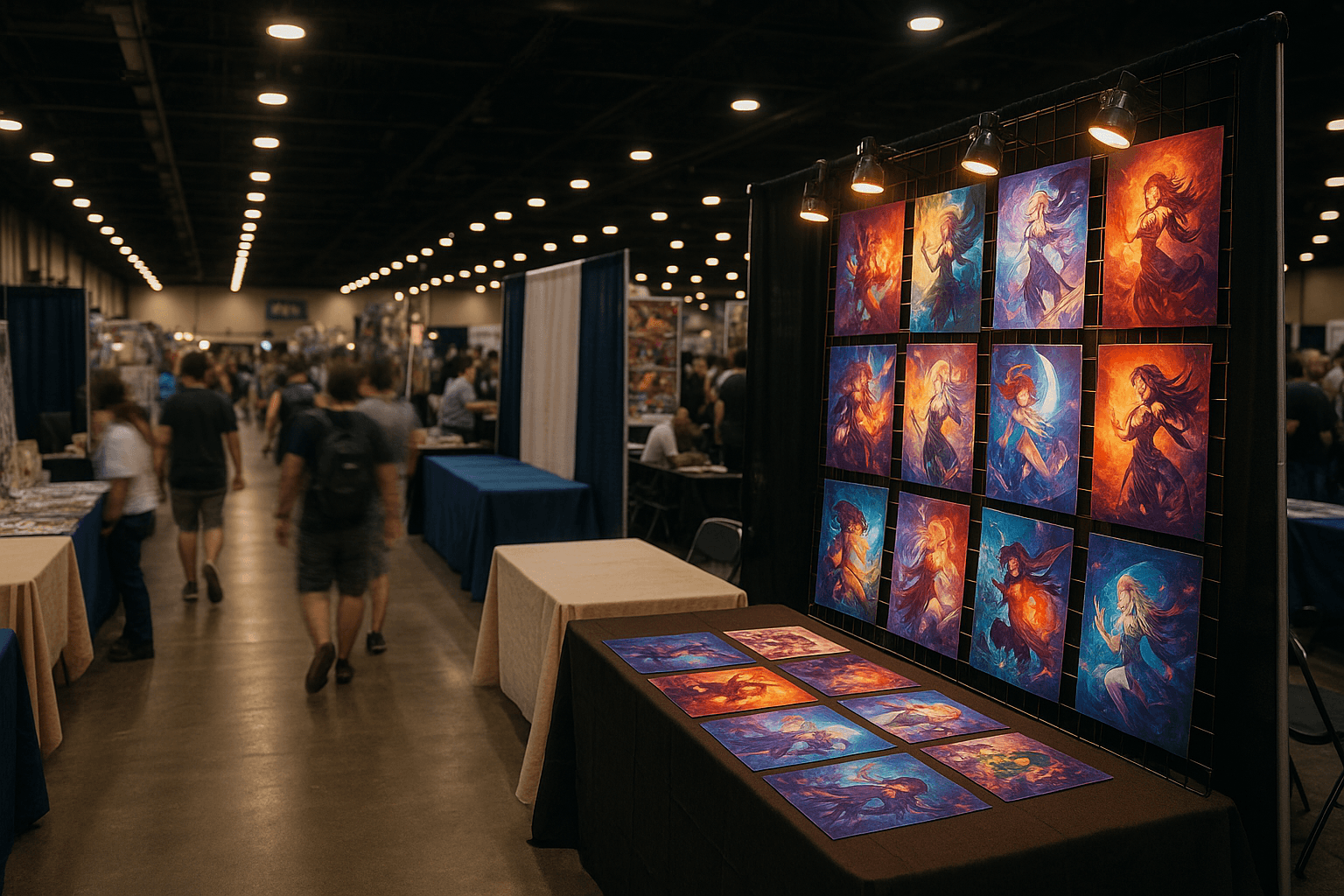
One vendor stares at their phone behind a flat table of merchandise, products laid out like a garage sale. The other has prints climbing a grid wall at eye level, warm lighting drawing attention from twenty feet away, and a steady stream of customers picking things up.
By the end of the day, one booth has cleared four figures. The other is packing up early.
The difference is almost never the product. It is the display. Here is what actually works, organized by the display principles that have the biggest impact on your sales, with specific products and prices so you can build your setup without guessing.
Go Vertical or Stay Invisible
This is the single biggest multiplier for convention sales. A flat table full of products is nearly invisible in a crowded convention hall. Attendees walk past hundreds of tables. Their eyes scan at head height, not waist height.
Vertical displays solve this immediately. When your products are at eye level, they get seen. When they get seen, they sell.
Grid wall panels ($50–$100 per set) are the most versatile fixture you can buy. They accept hooks, shelves, and clip-on baskets. You can hang prints, pin accessories to them, or mount shelving for boxed products. They fold flat for transport and reconfigure in minutes for different booth sizes.
If grid walls are too heavy for your setup, consider a tabletop pegboard display ($25–$40) or a wire grid cube storage system ($30–$60) that stacks vertically on your table.
The rule is simple: anything that can go vertical should go vertical. Stickers on a spinning rack outperform stickers flat on a table every single time.
Lighting Is a Direct Sales Driver
Convention halls have fluorescent overhead lighting that washes everything out equally. Every booth looks the same shade of flat and gray. Add your own lighting and you immediately stand out.
This is not a theory. Vendors who invest in booth lighting consistently report measurable increases in daily sales. As one experienced convention seller put it, "Investing in decent lighting absolutely increased my daily sales."
LED clip lights ($20–$50) are the go-to option. Clip them to your grid wall or the top of your display and aim them at your best products. Warm white LEDs make colors pop and create a sense of quality that overhead fluorescents destroy.
Go battery-powered. Electrical outlet access at convention venues costs $50–$150 extra, and the outlets are never where you need them. Rechargeable LED light bars and battery-powered clip lights eliminate the cord problem entirely and let you place light exactly where it matters.
Light your best products. Light your signage. Light the area where customers pick things up. Dark corners of your booth are dead zones where sales go to die.
Signage That Works at Every Distance
Your booth needs to communicate at three distances: far, medium, and close.
Far (30+ feet): A retractable banner stand ($30–$60) is visible from across the convention floor. Use it for your brand name, a single compelling image, and nothing else. This is what pulls people out of the walking stream and toward your booth. Keep the text large and the design bold.
Medium (5–10 feet): A custom branded tablecloth ($40–$80) tells approaching customers this is a professional operation. It hides your storage underneath and creates a clean, unified look. Match it to your brand colors.
Close (at the booth): Price lists should face every direction of approach. Not just the front of the table. Customers who approach from the side should be able to see prices without asking. The moment someone has to ask "how much is this?" you have introduced friction into the sale.
Print your prices clearly and large. Use simple signage holders or clip them to your grid wall. Include bundle pricing prominently: "3 stickers for $10" printed on a card right next to the sticker display.
Layout: Less Product, More Sales
This is counterintuitive, but a focused display of 15 strong products consistently outperforms 50 products crammed onto a table.
When a customer sees too many options, they freeze. When they see a curated selection with clear categories and breathing room between items, they pick things up. Picking things up is the first step to buying.
Layout principles that work:
- Front third of the table is your hot zone. Put your best sellers and impulse buys here.
- Eye-level products on your vertical display are what sell. Table-level items get overlooked.
- Group by category, not randomly. All prints together, all stickers together, all pins together.
- Leave open space. A packed table looks cheap. White space looks intentional.
- Bundle pricing increases transaction size. "3 for $10" versus $5 each pushes customers toward buying more. Display the bundles as bundles, physically grouped with a single price card.
Think of your booth like a retail store window. You are not showing inventory. You are showing the best version of what you sell.
Technology That Earns Its Table Space
A tablet or laptop playing process videos is a proven traffic magnet. People stop to watch how a product is made. That pause turns into browsing. Browsing turns into buying.
But here is where most vendors miss an opportunity: that same tablet can do double duty.
Instead of dedicating a device purely to video, consider running a kiosk ordering system that shows your catalog, plays media, and lets customers place orders directly. This solves one of the biggest silent killers of convention sales: the line problem.
Research shows that roughly 30% of interested customers walk away when they see a line of three or more people at a booth. They were ready to buy. They just were not ready to wait.
A tablet running ordering software like Shipyie lets customers browse your full catalog and place orders themselves while you handle other buyers. It works offline, which matters because convention Wi-Fi is notoriously unreliable. Customers get SMS tracking for their orders, and you get batch shipping labels for anything that needs to ship after the event.
The tablet earns its spot on your table by doing three jobs at once: attracting attention with visuals, reducing line abandonment, and capturing sales you would otherwise lose.
Cost-to-Impact Investment Table
Not every dollar spent on your booth delivers the same return. Here is how the most common display investments rank by their impact on actual sales:
| Display Investment | Cost | Sales Impact | Priority |
|---|---|---|---|
| Grid wall panels | $50–$100 | Very High — moves products to eye level | Buy first |
| LED clip lights (battery) | $20–$50 | High — direct sales increase reported | Buy first |
| Retractable banner stand | $30–$60 | High — visible from 30+ feet, pulls traffic | Buy second |
| Bundle pricing signage | $5–$15 | High — increases average transaction size | Buy first |
| Custom branded tablecloth | $40–$80 | Medium — professional appearance | Buy second |
| Tablet for video and ordering | $100–$300 | High — attracts attention + captures lost sales | Buy third |
| Price list displays | $10–$20 | Medium — removes purchase friction | Buy first |
| Electrical outlet access | $50–$150 | Low — avoid by using battery-powered gear | Skip |
Your First $150: What to Buy and in What Order
If you are building a convention booth display on a budget, this is the order that gets you the most sales increase per dollar:
- Grid wall panels ($50–$100) — The single biggest upgrade you can make. Vertical display changes everything.
- Battery-powered LED clip lights ($20–$50) — Clip to your grid wall. Warm white. Aim at your best products.
- Bundle pricing signage ($5–$15) — Print clear "3 for $10" cards. Place them next to the products.
- Price list holders ($10–$20) — Prices visible from every approach direction.
That is $85–$185 total and covers the fundamentals that drive the most sales.
Your next round of investment should add a retractable banner stand and a branded tablecloth. After that, a tablet running kiosk ordering software rounds out a professional setup that captures sales even when you are busy with another customer.
The vendors who sell the most at conventions are not the ones with the best products. They are the ones whose displays make it easy to see, easy to want, and easy to buy.
Build your booth for all three, and you will see the difference on day one.