
You spent weeks making product, drove two hours to the venue, and set up a gorgeous booth. Then you stood behind your table for six hours while shoppers walked right past.
Nine times out of ten, the problem is signage — or the lack of it.
Good signs do the selling before you ever open your mouth. They stop foot traffic, answer the three questions every shopper has ("What is this? How much? How do I pay?"), and keep working even when you are bagging someone else's order. Bad signs — or no signs — force every single customer interaction to start from zero.
This guide breaks down every sign your booth needs, what to put on each one, and how to build a complete signage kit without blowing your show budget.
Why Signage Matters More Than You Think
Craft show shoppers are moving fast. At a busy show, the average person walks past 80 to 150 booths in a few hours. They are scanning, not studying. You have roughly three to five seconds to catch someone's attention before they move on.
Signs give people a reason to stop. They also:
- Eliminate the awkward "how much is this?" conversation that makes introverted shoppers keep walking
- Project professionalism and build trust before a word is spoken
- Reinforce your brand so people remember you after the show
- Keep selling when you are busy helping another customer
Think of your signage as a silent employee who never takes a break.
The 6 Signs Every Booth Needs
1. Brand Banner (Your Billboard)
This is the single most important sign in your booth. It should be visible from at least 20 feet away — ideally from across an aisle.
What to include:
- Business name in large, bold lettering
- A short tagline or one-line description of what you sell
- Your logo if you have one
What to leave off:
- Your website URL (too small to read at distance)
- Phone number
- Long mission statements
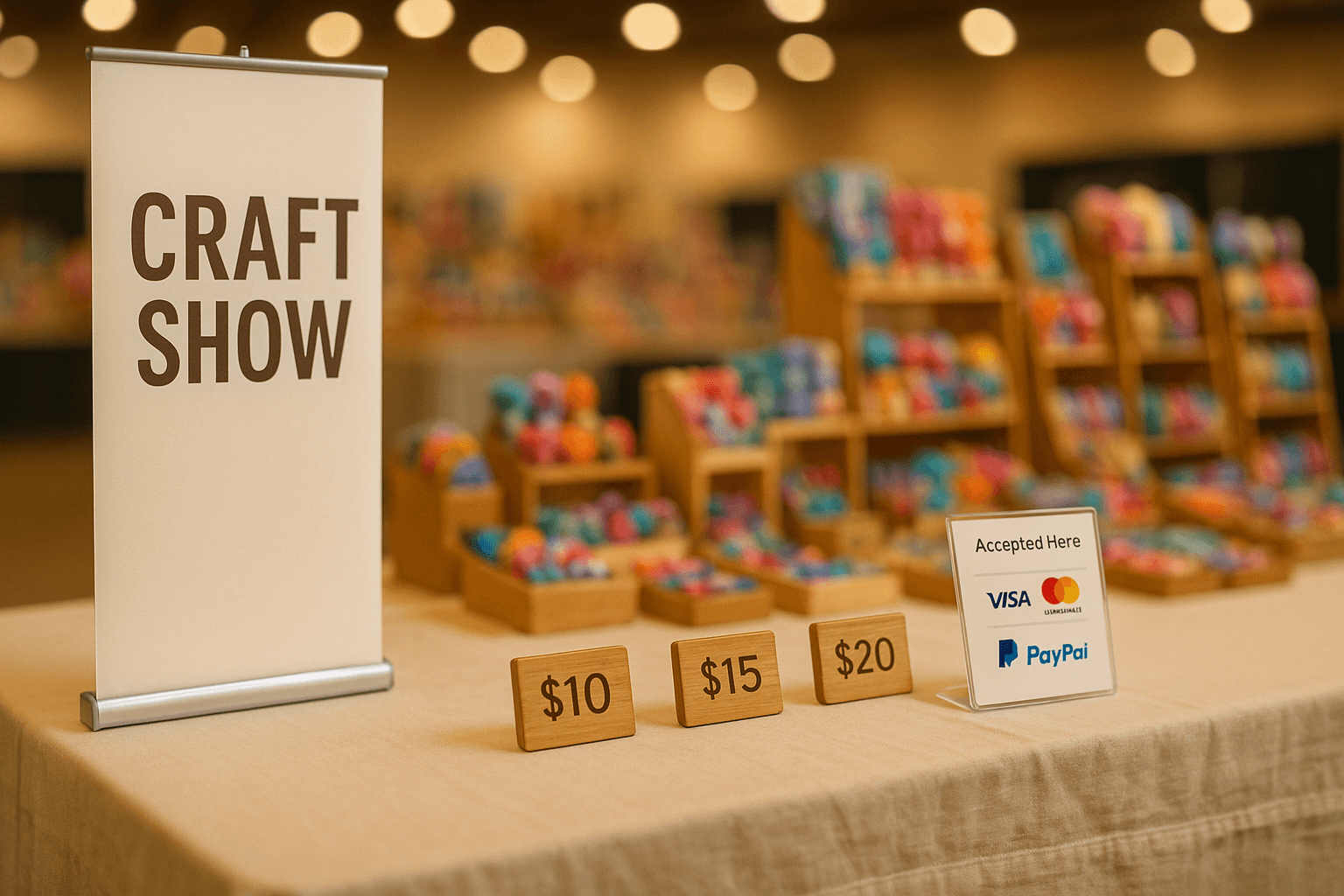
A retractable banner stand (33 by 80 inches is standard) is the most popular format. Position it behind you or at the side of your booth so it is visible above the table line.
Pro tip: Your tagline should answer the question "What do you sell?" in five words or fewer. "Hand-poured soy candles" works. "Artisan lifestyle products crafted with love and intention" does not.
2. Pricing Signs (Non-Negotiable)
This is where most vendors drop the ball. Every single item in your booth needs a visible price. No exceptions.
Here is the reality: a significant percentage of shoppers will not ask for a price. They will assume it is too expensive, or they will feel awkward, and they will walk away. You just lost a sale to silence.
Pricing sign formats that work
| Format | Best For | Approximate Cost |
|---|---|---|
| Small kraft tags tied to items | Individual products | $5 for 100 tags |
| Acrylic table tent signs | Product categories | $8–15 each |
| Wooden block signs | Rustic or handmade aesthetic | $3–5 each (DIY) |
| Printed price cards in holders | Clean, professional look | $10 for holders + printing |
| Chalkboard labels | Reusable, easy to update | $12 for a set of 6 |
Pricing display rules:
- Font size should be readable from 3 to 4 feet away (at minimum 24-point for table signs)
- Round to clean numbers when possible ($12 reads faster than $11.75)
- If you offer bundles or deals, call them out: "3 for $30 (save $6)"
- Group similar-priced items together and use a single category sign
3. Payment Methods Sign
Shoppers want to know how they can pay before they commit to buying. A small, visible sign near your checkout area eliminates friction.
What to include:
- Icons or text for every method you accept: Cash, Visa, Mastercard, Apple Pay, Venmo, etc.
- If you use a QR code for payment, make it scannable from a reasonable distance
Place this sign at the front of your table, angled toward the aisle, or near your register area. A 5-by-7-inch acrylic stand works well.
4. Your Story Sign (The About Me Board)
People buy from people at craft shows. A short story sign gives shoppers a connection point and differentiates you from the vendor two booths down selling similar products.
What to include:
- A two-to-three sentence origin story (why you started, what makes your process special)
- One specific detail that makes you memorable
Keep it short. Aim for 40 to 60 words maximum. Shoppers will not read a paragraph — they will read a caption.
Example:
"I started pouring candles in 2019 after I could not find a soy candle that actually smelled like real peaches. Every scent is developed and hand-poured in small batches in Durham, NC."
That is 34 words. It tells a story, names a specific detail, and builds trust.
5. Call-to-Action Signs (Stay Connected)
The show ends. Shoppers go home. If you did not capture their information, you are starting from scratch at the next event.
You need at least one sign that drives an action beyond the immediate sale.
Effective CTAs for craft shows:
- "Follow us on Instagram @yourbrand" with a QR code
- "Scan to shop online" linking to your website
- "Join our email list for 10% off your next order" with a sign-up sheet or QR code
- "Scan to reorder from home" for consumable products
QR code tips:
- Print QR codes at a minimum of 2 by 2 inches
- Test every QR code before the show
- Place QR codes at table height, not eye height — people scan downward with their phones
- Add a short text label above the code so people know what they are scanning
6. Special Offer or Feature Sign
This is optional but powerful. If you have a show-only deal, a new product, or a bestseller you want to highlight, give it a dedicated sign.
Examples:
- "NEW: Summer Collection — just launched this week"
- "Show Special: Buy 2, Get 1 Free"
- "Our #1 Seller — over 500 sold"
Place this sign at the front of your booth at eye level.
Font, Contrast, and Material Guidance
A sign with the right message in the wrong font is a wasted sign. Here are the rules.
Readability Rules
- Banner text: Readable from 20+ feet. Use fonts at 150-point or larger for your business name.
- Table signs: Readable from 6 to 10 feet. Minimum 36-point font for headlines, 24-point for details.
- Price tags: Readable from 3 to 4 feet. Minimum 18 to 24-point.
Font Selection
- Use a maximum of two fonts across all your signage (one for headlines, one for body text)
- Sans-serif fonts (like Montserrat, Poppins, or Helvetica) are easier to read at distance
- Script fonts are fine for a logo or tagline but never for pricing or critical information
- Bold weights outperform regular weights for readability
Contrast
High contrast is everything. Dark text on a light background or light text on a dark background. Avoid:
- Light gray text on white
- Yellow text on any light background
- Busy patterned backgrounds behind text
Indoor vs. Outdoor Materials
| Material | Indoor | Outdoor | Reusable | Cost Range |
|---|---|---|---|---|
| Foam board (printed) | Yes | No (warps in humidity) | Limited | $8–20 |
| Corrugated plastic (Coroplast) | Yes | Yes | Yes | $15–30 |
| Retractable banner | Yes | No (wind) | Yes | $40–80 |
| A-frame chalkboard | Yes | Yes | Yes | $25–50 |
| Acrylic table tents | Yes | Yes (weight them) | Yes | $8–15 each |
| Vinyl banner with grommets | Yes | Yes | Yes | $25–60 |
If you do both indoor and outdoor shows, invest in materials that handle both. Coroplast and vinyl banners are the workhorses.
Common Signage Mistakes (and How to Fix Them)
Mistake 1: No prices displayed. Fix: Price every item. Use category signs at minimum. This alone can increase your sales by 20% or more.
Mistake 2: Too much text. Fix: Cut your sign copy in half. Then cut it in half again. If a sign takes more than five seconds to read, it is too long.
Mistake 3: Signs that are too small. Fix: Print a draft, tape it to a wall, and walk 10 feet back. If you squint, the font is too small.
Mistake 4: Inconsistent branding. Fix: Use the same two fonts and two to three colors across every sign. Your booth should look like one cohesive brand, not a collection of random signs.
Mistake 5: Forgetting a CTA. Fix: Always have at least one sign that captures leads or drives online traffic. The sale at the show is good. The repeat customer for the next three years is better.
Mistake 6: Placing signs too low. Fix: Your brand banner should be above the table line. Eye-level signs should be at 4.5 to 5.5 feet, not sitting flat on the table where they are hidden by products.
Budget Breakdown: A Complete Signage Kit
Here is what a solid signage setup costs from scratch.
Complete signage kit cost
| Item | Quantity | Estimated Cost |
|---|---|---|
| Retractable banner stand (33x80 inches) | 1 | $50–75 |
| Printed acrylic table signs (5x7 inches) | 4 | $40–60 |
| Kraft price tags | 100 | $5 |
| Payment methods sign (small acrylic) | 1 | $10–15 |
| QR code sign for email/Instagram | 1 | $10–15 |
| Chalkboard sign (tabletop or A-frame) | 1 | $20–35 |
| Total | $135–205 |
You can cut costs by DIY-ing some items. Canva's free tier handles most sign designs. A local print shop can produce a retractable banner for under $60 if you supply the design file.
If your budget is extremely tight, start with these three: a retractable banner, price tags on every item, and a payment methods sign. Those three alone cover the most critical gaps.
A Quick Note on Post-Show Follow-Up
Great signage gets people to your booth and captures their info. But those leads go cold fast if you do not follow up. If you are collecting emails or Instagram follows at shows, you need a system to actually use them — send a thank-you email within 48 hours, post show recap content, or notify them when you are at the next event.
If you are juggling shows, orders, and leads across spreadsheets and sticky notes, Shipyie was built for exactly this. It gives convention vendors one place to manage orders, ship products, and follow up with every lead captured at your booth. You can try it free for 14 days — no credit card needed.
Your Signage Checklist
Before your next show, make sure you have:
- Brand banner visible from 20+ feet
- Price on every single item (or category pricing signs)
- Payment methods sign near your checkout area
- A short "about me" story sign
- At least one CTA sign (email signup, Instagram, QR to shop online)
- All signs tested for readability at the correct distance
- Consistent fonts and colors across all signage
- Materials appropriate for the venue (indoor vs. outdoor)
Get your signage right, and your booth does the selling for you — even when you are busy, even when you are tired, and even when the shopper is too shy to ask.