
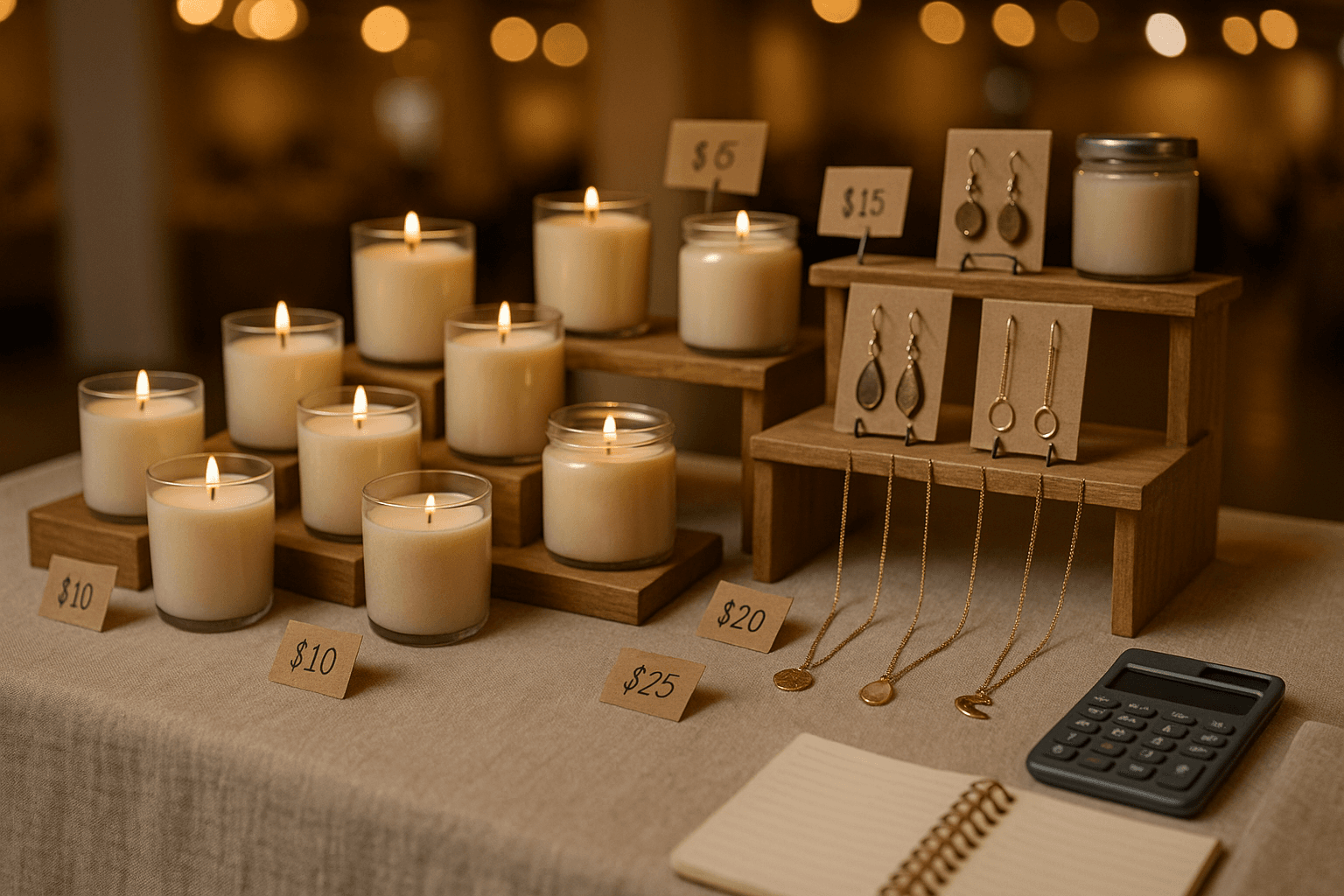
Let us start with a number that should make you uncomfortable. A candle maker in Ohio tracked every hour she spent on her business for a full month — sourcing wax, pouring, labeling, packing the car, working the booth, unpacking, restocking. When she divided her take-home by total hours, she was paying herself $1.87 an hour.
She is not alone. The most common pricing mistake at craft shows is not charging too much. It is charging so little that your "business" is actually an expensive hobby subsidizing strangers.
This guide gives you the exact math, the formulas, and the mindset shift to price your handmade items so your booth actually makes money. No theory. Just real numbers you can use before your next show.
Why Most Vendors Underprice (And Why It Hurts Everyone)
Underpricing comes from a good place. You love making things. You want people to enjoy them. You compare your prices to mass-produced Amazon alternatives and flinch.
Here is the problem: when you underprice, you do not just hurt yourself. You drag down pricing expectations for every vendor at the show. The woodworker next to you who priced correctly now looks "expensive" because your cutting boards are half the price they should be.
Underpricing also attracts the wrong customers — bargain hunters who will not become repeat buyers. The customers who value handmade work and will follow you to future shows are the ones willing to pay a fair price. They actually trust higher prices more, because they understand what real craftsmanship costs.
The Core Formula: Materials + Labor + Overhead, Then Double It
Every pricing conversation starts here:
(Materials + Labor + Overhead) x 2 = Retail Price
This is not a suggestion. It is the minimum viable formula for a business that pays its bills. Let us break each piece down with real dollars.
Materials: Track Everything, Not Just the Obvious
Materials are not just the wood, yarn, wax, or resin. They include:
- Raw materials (the obvious stuff)
- Packaging — bags, tissue paper, boxes, stickers, tags
- Labels and branding materials
- Failed batches and waste (plan for 5-10% waste)
- Tools that wear out — saw blades, molds, needles, punches
If you use a $40 silicone mold that lasts 200 pours, that is $0.20 per item in tooling cost. It adds up.
Example: A hand-poured soy candle might look like $2.50 in wax and fragrance. But add the tin ($1.10), wick ($0.15), warning label ($0.05), box ($0.75), tissue paper ($0.10), and branded sticker ($0.12), and your true material cost is $4.77.
Labor: Pay Yourself at Least $15-$25 Per Hour
This is where most vendors cheat themselves. Your time has value — a minimum of $15 to $25 per hour, depending on your skill level and market. If you have been doing this for years and have refined your craft, $25 is the floor, not the ceiling.
Labor includes:
- Actual making time
- Prep and cleanup
- Photography and listing time
- Packing and inventory management
- Booth setup and teardown (split across items sold)
- Drive time to and from shows
If a pair of hand-stamped earrings takes 20 minutes to make, that is $8.33 in labor at $25/hour. But you also spent 15 minutes photographing the design, 10 minutes packing your booth inventory, and the equivalent of 5 minutes of drive time per item. Now you are at 50 minutes — $20.83 in labor.
Overhead: The Costs Everyone Forgets
Overhead is the silent killer of craft show profits. These are real expenses that vendors routinely leave out of their pricing:
- Booth fees: $75 to $300+ per show
- Gas and travel: Round trip to shows, supply runs
- Insurance: General liability runs $175 to $279 per year for most craft vendors
- Card processing fees: 2.6% + $0.15 per transaction — on a $25 sale, that is $0.80
- Canopy, tables, displays: Amortize over their useful life
- Business licenses and permits
- Software and subscriptions for inventory, orders, or shipping
- Storage if you rent space for supplies or finished goods
To allocate overhead per item, estimate your total monthly overhead and divide by the number of items you expect to sell that month.
Example: If your monthly overhead is $600 and you sell 150 items per month, that is $4.00 in overhead per item.
Putting It All Together
Using our candle example:
| Cost Component | Amount |
|---|---|
| Materials | $4.77 |
| Labor (35 min at $25/hr) | $14.58 |
| Overhead allocation | $4.00 |
| Subtotal | $23.35 |
| x 2 = Retail Price | $46.70 |
Round that to $47 or $45, depending on your pricing strategy. If $45 feels high for a candle, remember: this is a hand-poured, premium product sold in person by the person who made it. That has value. Own it.
The "times two" multiplier is not pure profit — it covers wholesale margin if you ever sell to shops, absorbs the shows where sales are slow, and builds the cushion every real business needs.
Work Backward From Your Booth Fee
Here is a sanity check that brings pricing into sharp focus.
Say your booth fee is $150 for a Saturday market. You also spend $30 on gas, $15 on food, and $5 on parking. Your total cost to be at that show is $200 before you sell a single item.
Now ask: how many transactions do I need to break even?
| Average Item Price | Transactions to Cover $200 |
|---|---|
| $15 | 14 transactions |
| $25 | 8 transactions |
| $45 | 5 transactions |
| $75 | 3 transactions |
At $15 per item, you need 14 sales just to cover the booth — not your materials, not your labor, just the privilege of being there. At $45 per item, you need five.
Higher prices do not just mean more profit per sale. They mean fewer sales needed to hit your number, which means less inventory to make, pack, and haul.
Psychological Pricing That Works at Craft Shows
Online, $19.99 outperforms $20. In person, the rules are different.
At craft shows, round numbers ending in $5 or $0 work better. Here is why: most customers are handling cash, making quick decisions, and do not want to wait for change. $25 is easier than $24.99. $40 feels cleaner than $39.
Tiered pricing also works well in person:
- Entry price point: A small or simple item at $15-$20 that gets people to stop and engage
- Sweet spot: Your core product at $35-$50 where most revenue lives
- Premium piece: A showstopper at $75-$150 that makes everything else look reasonable
The premium item serves double duty. Even if it does not sell often, it anchors the perceived value of your booth. A $120 piece makes a $45 piece feel like a great deal.
The Emotional Block Around Raising Prices
Let us talk about the part nobody puts in a spreadsheet.
Raising prices feels terrifying. You imagine customers scoffing, walking away, whispering to each other. You picture an empty cash box at the end of the day.
Here is what actually happens, from a jewelry maker who raised her average price by 40% between spring and fall show season: "Every time I raise prices, sales go UP. Not just revenue — actual unit sales. People take me more seriously. They pick things up more carefully. They ask about my process."
This is not a fluke. Price signals quality. When your booth is full of $8 items, customers assume they are getting $8 quality. When your work is priced at $35 to $75, they assume — correctly — that they are getting something special.
If you are afraid to raise prices all at once, try this: raise prices on your next new product only. Or raise prices at a show where nobody knows your old prices. Test it. Track the results. You will have data instead of fear.
Common Pricing Mistakes to Avoid
Matching competitors who are also underpricing. If the vendor across the aisle sells similar items for less, that does not mean their price is right. They might be losing money and not know it yet.
Pricing based on what you would pay. You are not your customer. You know the cost of materials and think, "I would not pay $45 for this." Your customer does not know or care what the materials cost. They care how the item makes them feel.
Giving discounts to fill slow periods. Discounting trains customers to wait for deals. Instead, add value — throw in a small bonus item, offer gift wrapping, create a bundle.
Forgetting to re-price when costs change. Material costs, gas prices, and booth fees all change. Review your pricing every quarter. If your costs went up 10%, your prices need to go up at least 10%.
Tracking Sales and Knowing Your Numbers
Pricing only works if you track what happens after you set those prices. You need to know your average transaction value, your best sellers, your conversion rate, and which shows are worth rebooking.
This is where having a real system matters. Pen-and-paper tracking falls apart after three shows. Shipyie was built for exactly this — helping convention and craft show vendors take orders at the booth, ship products after the show, and capture leads from people who are not ready to buy yet. There is a 14-day free trial with no credit card required, so you can test it at your next show with zero risk.
When you can see your actual numbers — average order value, revenue per show, cost per transaction — pricing decisions stop being guesses and start being strategy.
Your Pricing Action Plan
Before your next show, do this:
- List every material cost for your top 5 products, including packaging and waste.
- Time yourself making each product. Include prep, cleanup, and finishing. Multiply by your hourly rate ($15-$25 minimum).
- Calculate your monthly overhead — booth fees, gas, insurance, processing fees, subscriptions — and divide by expected monthly units sold.
- Add it up and multiply by 2. That is your new retail price.
- Check it against the booth fee test. Can you break even in the first 2 to 3 hours of a show?
- Raise any prices that do not pass the test. Do it before your next event, not after.
Your craft has value. Price like it does.