
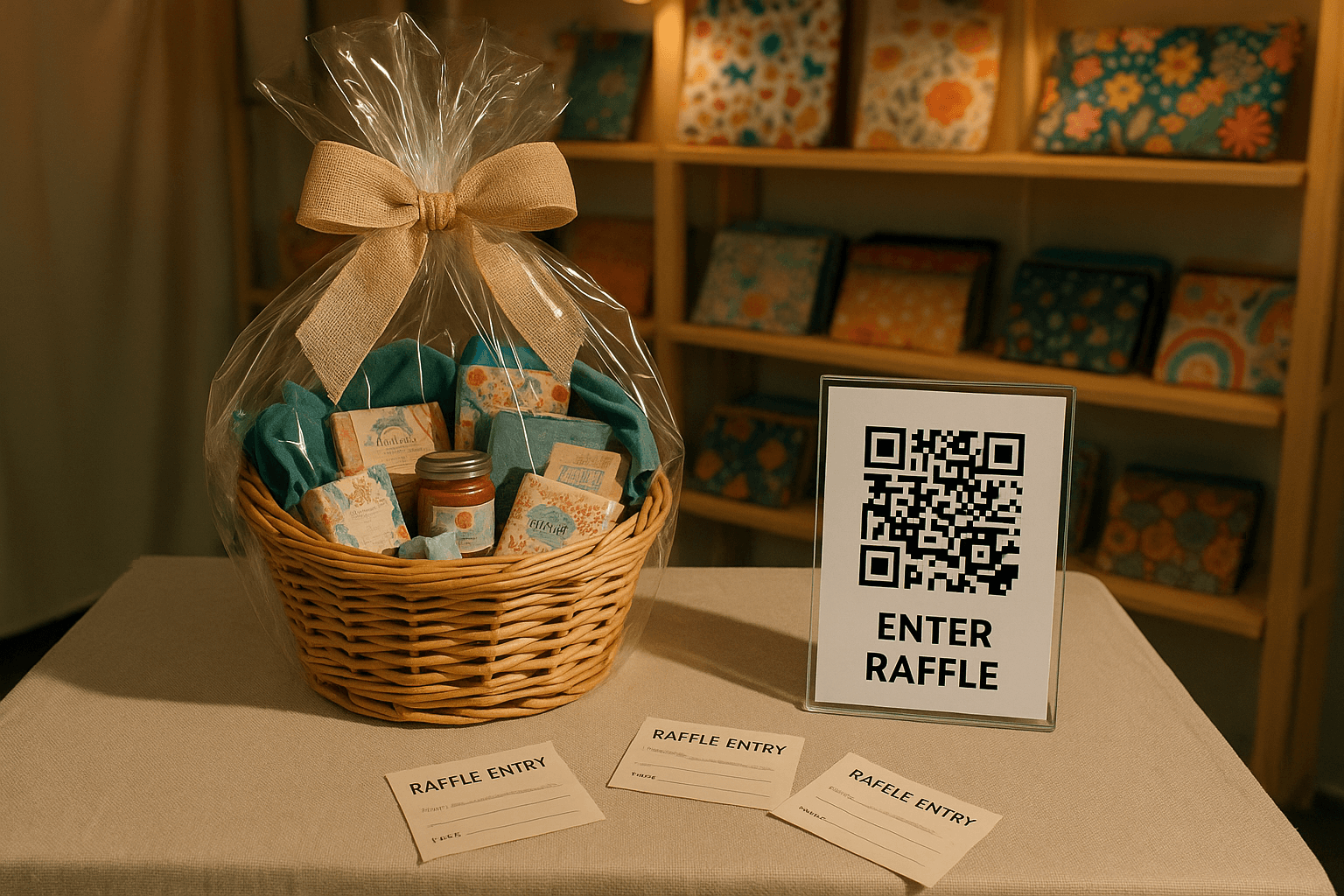
I watched the vendor across the aisle from me at a comic convention dump $200 worth of product into a fishbowl raffle. By the end of the weekend, she had a stack of paper slips with names she could barely read and email addresses that bounced. She gave away her best inventory and got nothing back.
Sound familiar?
Most booth raffles are just expensive giveaways dressed up as marketing. You pick a cool prize, toss a sign on the table, collect some chicken-scratch entries on torn paper, and then never follow up. The winner gets free stuff. You get a pile of napkins.
But here is the thing: a raffle for email signup is one of the highest-ROI moves you can make at a convention — if you do it right. The difference between a raffle that bleeds money and one that builds a real customer pipeline comes down to structure, prize selection, and follow-up.
This guide breaks down how to run booth raffles that actually pay for themselves and keep paying long after the show ends.
Why Most Booth Raffles Are a Waste of Money
Let's be honest about what typically happens. You set out your best product as a prize. People walk up, scribble their name on a slip of paper, and walk away. Maybe they glance at your booth for three seconds. Most of them are just collecting free raffle entries from every vendor on the floor.
The problems stack up fast:
- No qualifying intent. You are capturing names from people who want free stuff, not people interested in your products.
- Paper entries are a graveyard. Half the handwriting is illegible. The other half has fake emails. You lose 30-50% of entries before you even start.
- No follow-up system. Even if you get real emails, you probably won't send anything until the next show — if ever.
- Prize cannibalization. Giving away your most expensive item means you just lost margin on a sale that might have happened anyway.
The whole model is backwards. You are optimizing for traffic instead of leads. A line at your booth means nothing if those people vanish the moment they drop their entry in the bowl.
The Math: What an Email Subscriber Is Actually Worth
Before you decide raffle giveaways are not worth it, let's look at what a qualified email address is actually worth to a convention vendor.
Email subscriber value by conversion scenario
Here is a conservative model. Say you sell handmade goods with an average order value of $45, and you do 8-10 shows per year.
| Metric | Conservative | Moderate | Aggressive |
|---|---|---|---|
| Emails collected per show | 40 | 75 | 120 |
| Valid email rate | 70% | 85% | 95% |
| Purchase within 12 months | 8% | 12% | 18% |
| Average order value | $35 | $45 | $60 |
| Revenue per show's emails | $78 | $344 | $1,231 |
Even at the conservative end, each real email address is worth nearly $2 in future revenue. At the moderate level — which is realistic if you actually follow up — you are looking at $4-5 per email. Collect 75 emails at a show and that is $344 in downstream revenue from a single weekend.
Now compare that to a raffle prize that costs you $25-50. If it captures 75 valid emails worth $344, your return is 7-14x. That is better ROI than almost anything else you can do at your booth.
Want to run the numbers for your specific business? Use the free Raffle ROI Calculator to plug in your own average order value, show count, and conversion rates.
What Makes a Great Raffle Prize
Here is the counterintuitive part: your best raffle prize is not your most expensive product. It is the item that attracts your ideal customer while costing you the least.
The Sweet Spot Formula
Your raffle prize should hit three criteria:
- High perceived value, low actual cost. A bundle of small items often looks more impressive than a single expensive piece, and costs you less.
- Relevant to your target buyer. If you sell leather goods, raffle a leather care kit plus a small accessory — not a gift card to somewhere else. You want entries from people who actually care about what you sell.
- Conversation starter. The prize should give you a reason to talk about your products.
Prize Ideas by Budget
Under $20 actual cost:
- Curated sample pack of your products
- "Mystery bag" with 3-4 small items
- Exclusive colorway or limited item not available for purchase
$20-50 actual cost:
- Bundle of your top 3 bestsellers (at your cost, perceived at retail)
- Gift certificate to your online store (costs you nothing until redeemed)
- "VIP pre-order access" for your next launch plus a small freebie
$50+ actual cost:
- Custom or one-of-a-kind piece (high perceived value, no retail comparison)
- Experience package (e.g., custom order consultation plus a product)
The "mystery bag" approach works especially well because it creates curiosity. People ask what is in it, which gives you a conversation opener. And it lets you use items that are hard to sell individually — end-of-run pieces, slight seconds, samples — turning dead inventory into lead generation.
How to Set Up a Frictionless Signup Flow
This is where most vendors leave enormous amounts of value on the table. The signup experience determines whether you capture 30 emails or 130 emails at the same show.
Paper vs. Digital: It Is Not Close
Paper entry forms seem simple, but they create friction everywhere:
- People have to find a pen
- They rush through it because there is a line
- Handwriting is unreadable
- You have to manually enter everything later (you will not)
- No duplicate detection — some people enter five times
Digital capture flips every one of those problems. A QR code that customers scan with their phone lets them type their own email (correctly), takes five seconds, and the data goes straight into a system you can actually use.
The QR Code Setup That Works
Here is the flow that gets the highest conversion at booths:
- Print a clear sign with the prize displayed, a QR code, and three words of instruction: "Scan. Enter. Win."
- Customer scans the QR code with their phone camera — no app needed.
- A simple form loads asking for name and email. Nothing else. Every extra field cuts your conversion rate by 10-15%.
- Confirmation screen says "You're entered! Winner announced [date]." Optionally show a discount code for shopping today.
- Entries flow into your lead capture system automatically, deduplicated and validated.
This is exactly the kind of flow that Shipyie's QR code email capture is built for. Customers scan your booth QR code, enter their info, and they are automatically entered in your raffle — no paper, no manual entry, no lost leads.
Placement Matters
Put the QR code sign:
- At the front edge of your table, not behind your products
- At eye level when someone is standing, not flat on the table
- Next to the prize, so people connect the two immediately
- Facing foot traffic, not just people already in your booth
A well-placed QR code sign with a visible prize can capture entries from people who are just walking by — they scan, enter, and keep moving. Those passive captures add up fast.
The 5 Raffle Formats That Work Best at Conventions
Not all raffles work the same way. The format you choose affects how many entries you get, the quality of those leads, and whether people actually engage with your booth.
1. The Classic Drawing
Enter anytime during the show. Winner drawn at the end of the last day or announced via email after.
Best for: High-traffic shows where you want maximum entries with minimum booth interaction.
2. The Hourly Drawing
Draw a small winner every hour. Grand prize at the end.
Best for: Keeping a crowd around your booth throughout the day. Creates urgency and repeat visits. People come back to check if they won, giving you another selling opportunity.
3. The Purchase Bonus Entry
Everyone can enter once for free. Customers who make a purchase get 3 extra entries.
Best for: Driving sales while building your list. The free entry captures browsers; the bonus motivates buyers.
4. The Spin-to-Win
Enter your email, then spin a physical wheel. Everyone wins something — discount codes, stickers, small items — but one slot is the grand prize.
Best for: Creating a spectacle. The wheel draws attention from across the aisle and creates a "what did you win?" buzz. Typically captures 100-180 entries per day.
5. The Social Amplifier
Enter once by email. Get a bonus entry for tagging a friend or sharing on social media.
Best for: Extending your reach beyond the people physically at the show.
Which format fits your booth?
The right choice depends on your primary goal.
| Goal | Best Format | Why |
|---|---|---|
| Maximum email volume | Spin-to-Win | Spectacle draws crowds |
| Highest lead quality | Purchase Bonus Entry | Filters for buyers |
| Repeat booth visits | Hourly Drawing | People come back to check |
| Social media growth | Social Amplifier | Built-in sharing mechanic |
| Simplest to run | Classic Drawing | Set it and forget it |
Most vendors start with the Classic Drawing because it is easiest. But if you are doing more than 4-5 shows per year, experiment with the Hourly Drawing or Spin-to-Win — the engagement difference is dramatic.
Post-Show: What to Do With Your Email List in the First 48 Hours
Here is where the real money is made, and where 90% of vendors completely drop the ball.
You just collected 80 email addresses. Every hour that passes, those people forget who you are. The 48-hour window after a show is the highest-engagement period you will ever have with these leads.
The 48-Hour Email Sequence
Email 1 — Send within 6 hours of the show ending:
Subject: "[Show Name] raffle winner + a thank you"
- Announce the winner (or say the winner has been notified privately)
- Thank everyone for stopping by your booth
- Include one photo from your booth setup — it helps people remember you
- Offer a "show special" discount code valid for 72 hours (10-15% works)
- Keep it under 150 words
Email 2 — Send 24-36 hours after Email 1:
Subject: "That [product they saw] is going fast"
- Highlight your 2-3 bestsellers from the show
- Mention that the show special expires soon
- Include a direct link to your shop
Email 3 — Send 5-7 days after the show:
Subject: "Coming up next"
- Tell them about your next show or product launch
- Invite them to follow you on social media
- This transitions them from "raffle entrant" to "subscriber"
Vendors who send that first email within 6 hours see open rates of 45-55%. Wait 48 hours and that drops to 20-25%. Wait a week and you are below 15%.
That first email is not optional. It is the entire reason you ran the raffle.
For more strategies on collecting emails beyond raffles, check out our guide on how to build an email list at craft shows.
How to Calculate Your Raffle ROI
Raffle ROI is straightforward once you track the right numbers:
Raffle ROI = (Revenue from raffle leads - Prize cost - Setup cost) / Total cost × 100
You need to track:
- Prize cost: Your actual cost, not retail value
- Setup cost: Signs, QR code stands, wheel if applicable
- Emails captured: Total valid entries
- Conversion rate: Percentage who purchase within 90 days
- Average order value: From those conversions
Most vendors never calculate this because they do not track conversions from raffle leads separately. The fix is simple: use a unique discount code in your post-show emails that you only give to raffle entrants. Every sale with that code is directly attributable to your raffle.
Run your own numbers with the free Raffle ROI Calculator. Plug in your prize cost, expected entries, and average order value to see whether your next raffle is worth it before you spend a dime.
Common Mistakes That Tank Your Conversion Rate
These are the mistakes that kill raffle performance over and over.
Asking for too much information. Name and email. That is it. Every additional field costs you 10-15% of entries.
Hiding the prize. If people cannot see the prize from six feet away, they will not walk over. Display it prominently, unwrapped and visible.
No urgency mechanism. "Enter our raffle" is weak. "Drawing in 2 hours — 23 entries so far" is strong.
Forgetting the call to action. After someone enters the raffle, have a one-liner ready: "While you are here, our bestseller is this one right here — would you like to take a look?"
Not segmenting raffle leads. Someone who entered your raffle and bought something is a very different lead than someone who only entered the raffle. Tag them differently. Email them differently.
Running the same raffle every show. If you do the same circuit, repeat attendees will tune out the same raffle. Rotate your prizes and formats.
No system for follow-up. If your plan is "I will figure it out after the show," you will not do it. Have your email sequence written before you leave for the convention.
Make Your Next Raffle Count
A booth raffle is not a cost center. It is a lead generation machine — but only if you treat it like one. Choose a prize that attracts your ideal customer, make entry frictionless with a QR code, follow up within 6 hours, and actually track your ROI.
The vendors who build real email lists at conventions are not doing anything complicated. They are just doing the basics consistently and following up when everyone else forgets.
Ready to set up QR code email capture for your next show? Start your free 14-day trial of Shipyie — no credit card required.