
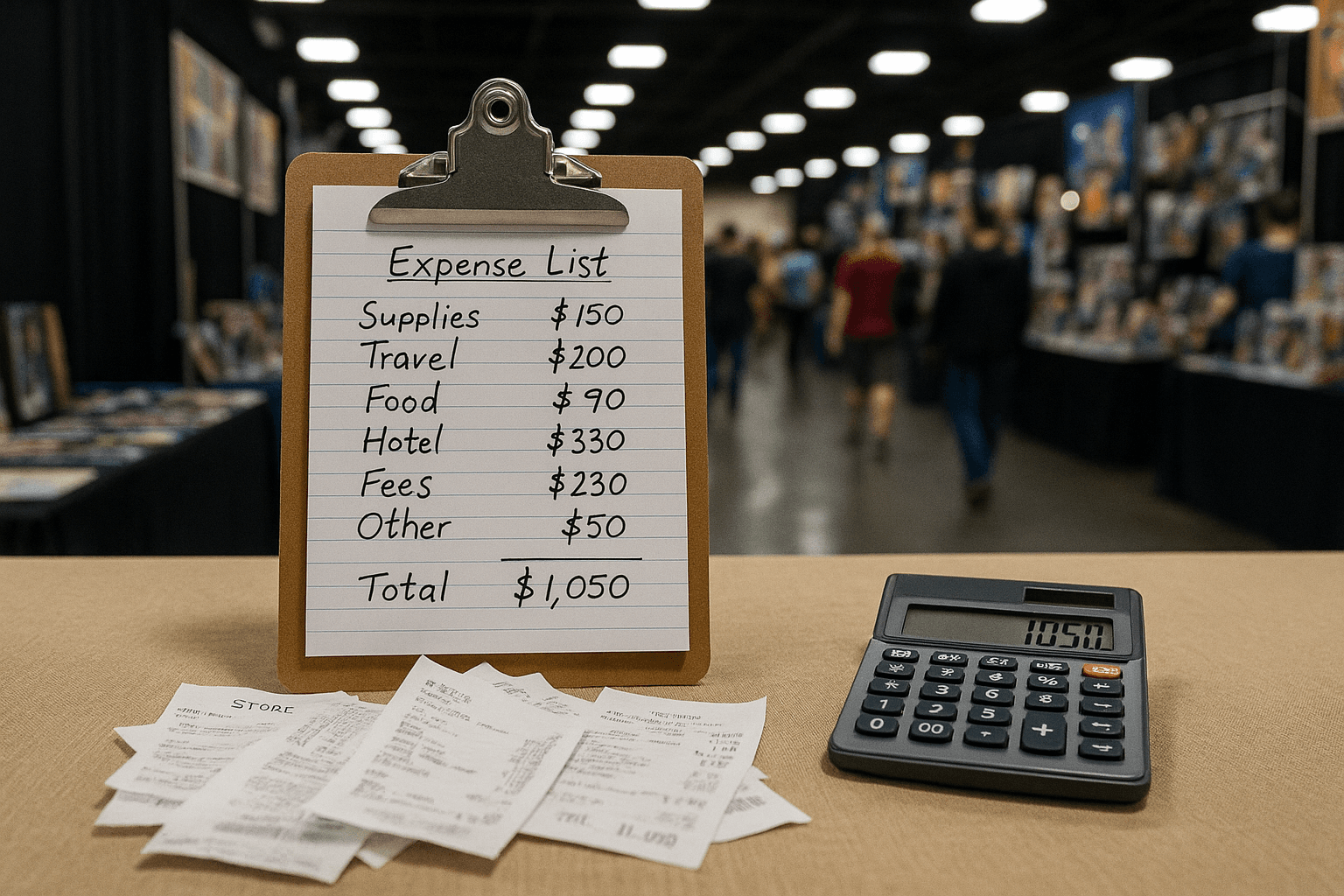
You just got home from a three-day comic con. Your cash box feels heavier, your Square app shows a decent number, and your gut says, "Yeah, I think I did okay."
But did you? Really?
When you subtract the booth fee, the hotel, the gas, the meals, the credit card processing fees, the product you gave away as samples, and the eight hours of prep time — did you actually make money? Or did you pay several hundred dollars for the privilege of standing behind a table for three days?
Most convention vendors never answer that question honestly. And it is the single biggest reason they keep returning to shows that quietly bleed them dry year after year.
This guide walks through exactly how to track every convention expense, calculate your true profit per show, and build a simple scorecard that tells you — with real numbers, not gut feelings — which shows deserve your time and which ones you should drop.
Why "I Think I Did Okay" Is Killing Your Vendor Business
Here is a scenario that plays out thousands of times every convention season: A vendor grosses $1,800 at a weekend show. They paid $400 for the booth. Quick mental math says they made $1,400. That feels great.
But the actual math looks different:
- Booth fee: $400
- Hotel (two nights): $340
- Gas and tolls (round trip): $120
- Meals on the road: $85
- Product cost of goods sold: $540
- Credit card processing fees: $52
- Parking at venue: $30
- New tablecloth and display items: $65
- Printed materials and business cards: $40
- Shipping supplies used: $35
Total expenses: $1,707
Actual profit: $93
That is a 5.2% profit margin for a weekend of work. If that vendor spent 30 hours between prep, travel, setup, selling, teardown, and follow-up, they earned roughly $3.10 per hour.
The problem is not that the show was bad. The problem is that without tracking, this vendor will book the same show next year, tell friends it was "pretty good," and never realize they are essentially volunteering.
For a deeper look at what shows actually cost before you even make a sale, read our breakdown on how much it costs to sell at a convention.
The 10 Expense Categories Every Vendor Should Track
Most vendors remember the big-ticket items — the booth fee, maybe the hotel. But profitability lives in the details.
Convention expense categories and typical ranges
The table below shows each category with typical cost ranges based on a standard weekend show within driving distance.
| Category | Examples | Typical Range |
|---|---|---|
| Booth / Table Fee | Table, booth space, corner upgrade, electricity | $150 – $800 |
| Travel | Gas, tolls, mileage, flights, rental car | $40 – $400 |
| Lodging | Hotel, Airbnb, shared room | $0 – $500 |
| Meals & Incidentals | Food on the road, coffee, snacks, tips | $30 – $150 |
| Cost of Goods Sold | Raw materials, wholesale cost of products sold | 25% – 50% of revenue |
| Payment Processing | Square, Stripe, PayPal fees on card transactions | 2.6% – 3.5% of card sales |
| Display & Setup | Tablecloths, risers, signage, lighting, banners | $0 – $200 (amortized) |
| Marketing Materials | Business cards, flyers, stickers, QR code stands | $15 – $75 |
| Shipping & Supplies | Bags, tissue paper, boxes, labels, return shipping | $20 – $100 |
| Miscellaneous | Parking, Wi-Fi hotspot, assistant pay, permits | $0 – $300 |
Cost of goods sold (COGS) is the one most vendors dramatically undercount. If you sell handmade items, you need to factor in raw materials at minimum. If you resell, you need the wholesale cost of every unit that left your table.
Display and setup costs should be amortized across shows. If you bought a $200 banner stand and you do 20 shows a year, that is $10 per show.
The Simple Rule
If you spent money because of a show — before, during, or after — it is an expense for that show. No exceptions.
Hidden Costs Most Vendors Forget
Beyond the ten categories above, there are expenses that are real but easy to overlook.
Payment processing fees deserve special attention. If 70% of your sales are card transactions and you gross $2,000, you are paying roughly $36–$70 in processing fees depending on your provider. Over a season of 15 shows, that is $540–$1,050 that never hits your bank account.
Wear and tear on equipment is another one. Your canopy tent, folding tables, dollies, and bins all have a lifespan. A $300 pop-up tent that lasts 40 shows costs $7.50 per event.
Return shipping and post-show fulfillment catches vendors off guard. If you take orders at the booth and ship later, every label, box, and minute of packing time is a cost tied to that event.
Inventory shrinkage also belongs here. Products get damaged in transit, items walk off the table, and samples get handed out. If you started the weekend with 200 units and came home with 155 but only rang up 40 sales, five units disappeared somewhere. That is real cost.
How to Calculate True Profit Per Show
Revenue minus booth fee is not profit. Here is the formula that actually matters:
True Profit = Gross Revenue − COGS − All Event Expenses
And if you want to take it one step further:
Hourly Rate = True Profit ÷ Total Hours Invested
Total hours includes prep time, travel time, setup, the show itself, teardown, drive home, unpacking, and any post-show follow-up or order fulfillment.
Let us walk through a real example. Say you do a Saturday-only craft fair:
- Gross revenue: $1,200
- COGS (40% of revenue): $480
- Booth fee: $175
- Gas: $45
- Meals: $25
- Processing fees (65% card rate): $20
- Supplies and bags: $15
- Marketing materials: $10
Total expenses: $770
True profit: $430
Now for hours: 3 hours of prep the night before, 1 hour of travel each way, 1 hour setup, 8 hours selling, 45 minutes teardown, 1 hour unpacking at home. That is roughly 15.75 hours.
Hourly rate: $27.30
That is a decent single-day show. But now compare it to a three-day convention where you gross $2,500 but spend $1,900 in total expenses and invest 40 hours. Your hourly rate drops to $15. Suddenly that big revenue number does not look so impressive.
If you want to run these numbers quickly, try our free Convention Expense Tracker. Plug in your costs and it calculates true profit and break-even instantly.
Building a Show Scorecard: The 5 Metrics That Matter
Tracking expenses is step one. Step two is turning that data into a scorecard you can use to compare shows side by side.
1. True Profit Margin — (True Profit ÷ Gross Revenue) × 100. Anything below 20% should raise questions. Below 10% is a red flag.
2. Revenue Per Hour — Gross Revenue ÷ Total Hours Invested. Measures efficiency.
3. Profit Per Hour — True Profit ÷ Total Hours Invested. This is the number that matters most. Set a minimum threshold — say $25/hour — and hold every show to it.
4. Lead Capture Rate — (Leads Collected ÷ Estimated Booth Traffic) × 100. If you captured 80 email addresses from a show that barely broke even, the long-term value might justify a return.
5. Return Customer Rate — Track how many customers from a specific event come back to buy online later.
Sample show comparison scorecard
The following table shows a side-by-side comparison of three fictional shows.
| Metric | Spring Craft Fest | Comic Con East | Holiday Market |
|---|---|---|---|
| Gross Revenue | $1,200 | $3,100 | $2,400 |
| True Profit | $430 | $310 | $1,050 |
| True Profit Margin | 35.8% | 10.0% | 43.8% |
| Profit Per Hour | $27.30 | $7.75 | $35.00 |
| Leads Captured | 22 | 95 | 48 |
Looking at revenue alone, Comic Con East wins. Looking at the metrics that actually measure business health, it is the worst show of the three.
Using Data to Decide Which Shows to Repeat and Which to Drop
Once you have a few shows scored, patterns emerge fast. Here is a simple framework:
Repeat without hesitation: Profit margin above 30%, profit per hour above your minimum threshold, and the show fits your schedule and energy level.
Repeat with adjustments: Decent margin but room to improve. Maybe you overspent on the hotel, brought too much inventory, or did not capture enough leads. Book it again but fix the leaks.
Put on probation: Margin between 10–20% or profit per hour below your threshold, but the show has other value — great networking, strong lead capture, or growing attendance. Give it one more year with tighter cost control.
Drop immediately: Margin below 10%, profit per hour below minimum wage, low lead capture, and no strategic value. Do not let nostalgia or sunk cost keep you going back.
With Shipyie's event analytics dashboard, you can track per-event revenue, compare shows side by side, and see exactly which events are pulling their weight. It logs sales in real time as you ring up orders at the booth. Plans start at $29/month with a 14-day free trial — no credit card required.
Case Study: How Tracking Expenses Helped One Vendor Cut 4 Unprofitable Shows
Sarah sells handmade jewelry at conventions and craft fairs across the Southeast. In 2025, she did 18 shows. She felt like she had a good year — total gross revenue was around $38,000.
But when she sat down in January and tracked every expense for every show, the picture changed.
Six of her 18 shows had a true profit margin below 15%. Four of those six were below 8%. Those four shows had something in common: they were all multi-day events with travel, hotel stays, and booth fees above $500.
Here is what the numbers revealed:
- Those 4 shows generated $12,400 in revenue but only $820 in combined true profit
- They consumed 11 weekends (including prep and recovery days)
- They accounted for roughly 160 hours of her time
Meanwhile, her best 6 shows — all single-day events within a two-hour drive — generated $14,200 in revenue and $6,100 in true profit in about 95 total hours.
Sarah dropped all four underperforming shows for the next season. She replaced two of them with local events that had lower booth fees and zero hotel costs. She left the other two weekends open for online sales, restocking, and rest.
The result: she worked fewer weekends, spent less money, and her season profit increased by over 30%.
Start Tracking Today
You do not need fancy software to begin. A simple spreadsheet works. But if you want a head start, our free Convention Expense Tracker is built specifically for vendors. It walks you through every expense category, calculates your true profit and break-even, and gives you a clear summary for each show.
The best time to start tracking was your first show. The second best time is your next one.