
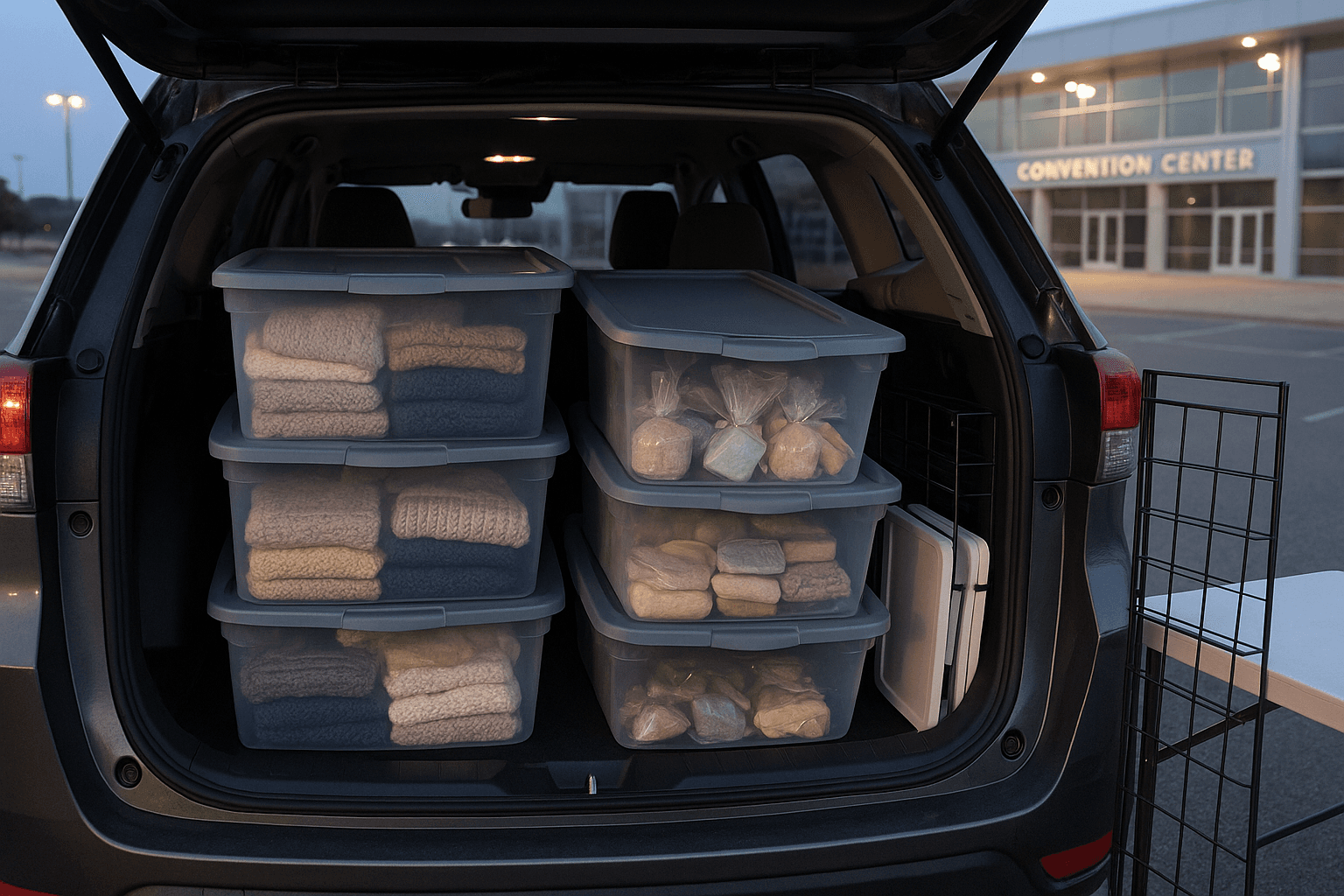
You know the two worst feelings as a craft show vendor? Selling out by noon on a two-day show and watching hundreds of potential customers walk past your empty table. Or dragging 40 pounds of product in, selling six pieces, and dragging it all back to your car at the end of the night.
Both of those scenarios come from the same root problem: you guessed instead of calculated.
Figuring out how much inventory to bring to a craft show is not a gut feeling exercise. There are real formulas, real benchmarks, and a straightforward system you can use whether it is your first show or your fiftieth. This guide breaks all of it down with actual numbers.
The Core Formula: The 5x Rule
The simplest starting point is the 5x rule. Take the amount of revenue you want to earn at the show and multiply it by five. That is how much retail value in inventory you need to bring.
Want to make $500 at the show? Bring $2,500 in retail value.
Want to hit $1,000? You need $5,000 worth of product on hand.
Why five times instead of just bringing what you hope to sell? Because not every customer buys. Not every product appeals to every person. And you need enough variety and volume to keep your booth looking full for the entire duration of the show. The industry planning target is a 75% sell-through rate, meaning you should expect to take about a quarter of your inventory back home.
The Booth Fee Method
If the 5x rule feels abstract, try the booth fee method. Take your booth fee and multiply it by 8 to 10. That is your target sales number. Then multiply by 3 to get the inventory to bring.
- Booth fee: $200
- Target sales: $200 x 10 = $2,000
- Inventory to bring: $2,000 x 3 = $6,000 in retail value
Both formulas converge on the same principle: bring 3 to 5 times your expected sales in retail value.
Understanding Conversion Rates
One number most new vendors ignore is the conversion rate — the percentage of total show foot traffic that actually buys from you.
- 1% conversion: Acceptable, especially for higher-priced items
- 3% conversion: Good, solid performance
- 5% conversion: Excellent
If a show expects 2,000 attendees and you convert at 3%, that is 60 transactions. If your average transaction value is $40, you are looking at $2,400 in sales. Now back into your inventory number: $2,400 x 3 = $7,200 in retail value to bring.
Here are typical average transaction values by category:
| Product Category | Average Transaction |
|---|---|
| Prints and art reproductions | $15 - $25 |
| Candles and home fragrance | $18 - $35 |
| Handmade jewelry | $35 - $60 |
| Ceramics and pottery | $40 - $80 |
Product Mix: What to Bring More Of
Raw volume is only part of the equation. The mix matters just as much.
Lead with your best sellers. If you have three products that consistently outsell everything else, those should make up 40 to 50 percent of your total inventory.
Include a range of price points. Entry-level items ($10-$20) lower the barrier to purchase. Mid-range products ($30-$60) form your bread and butter. A few premium pieces ($80+) anchor the perceived value of your booth.
A practical split:
- 50% — Best sellers and proven movers
- 25% — Mid-tier variety
- 15% — Entry-level impulse buys
- 10% — Premium display and anchor pieces
Display Psychology: The 40% Threshold
A booth starts looking "picked over" when it drops below 40% full. That means if you sell steadily through the morning, by early afternoon your display can look sparse even though you still have plenty of product.
How to Handle a Thinning Display
Consolidate inward. As items sell, pull remaining products toward the center and front. Eliminate empty risers and remove bare shelving tiers.
Stage reserve stock under your table. Bring bins of backup inventory beneath your tablecloth. When a section thins out, replenish from below.
Reduce your display footprint intentionally. If you sell through a lot of product, fold one table section and concentrate what is left into a tighter, curated presentation. A small booth that looks intentional beats a large booth that looks ransacked.
When You Are Selling Fast
If you are blowing through inventory ahead of schedule, take notes. What is selling? What price points are moving fastest? Which items are people asking about that you have already sold?
If you can, call in reinforcements — have someone bring additional stock. If not, shift to taking pre-orders for items you have sold out of. Capture the customer's information, process the order, and ship it after the show. This turns a stockout from a dead end into a revenue opportunity.
This is where having a system for order capture and shipping pays off. Instead of handing someone a business card and hoping they remember to visit your website later, you can take the order on the spot. Shipyie is built specifically for this — letting convention and craft show vendors take orders at the booth and ship products after the show. Plans start at $29/month with a 14-day free trial and no credit card required.
Adjusting Your Formula After Your First Show
The formulas above are starting points. After your first show, you have actual data.
Track These Numbers at Every Show
- Total inventory brought (retail value)
- Total sales (revenue)
- Number of transactions
- Items sold by category
- Time of day sales occurred
- Foot traffic estimate
Calculate Your Real Metrics
- Sell-through rate: Total sales / Total inventory brought. Brought $5,000, sold $2,000? That is 40%.
- Average transaction value: Total sales / Number of transactions.
- Conversion rate: Number of transactions / Estimated foot traffic.
Adjust for Next Time
If your sell-through was above 75%, you under-stocked. Bring more next time.
If your sell-through was below 50%, you over-stocked or your product mix was off.
If your sell-through was 50 to 75%, you are in the sweet spot. Fine-tune your product mix.
After three to five shows, your personal formula will be dialed in tighter than any generic rule could ever be.
The Pre-Show Inventory Checklist
One week before:
- Calculate target sales using the 5x rule or booth fee method
- Confirm product mix percentages
- Count and tag all inventory
- Prepare reserve stock bins for under-table staging
Day before:
- Pack inventory in labeled bins by category
- Load reserve stock separately from display stock
- Prepare consolidation plan
- Charge all devices
Morning of:
- Set up full display before doors open
- Position reserve bins within easy reach
- Note starting inventory count
During the show:
- Replenish display from reserves as items sell
- Track what sells out and when
- Consolidate display when it drops near 40% full
- Take pre-orders for sold-out items
The Bottom Line
How much inventory to bring to a craft show comes down to math, not magic. Use the 5x rule or the booth fee method to set your baseline. Weight your product mix toward proven sellers. Plan your display consolidation strategy in advance. Track your numbers religiously. And have a plan for what happens when the good stuff sells out.
The vendors who consistently do well at shows are not luckier than everyone else. They just stopped guessing and started calculating.