
You just got accepted to your first craft show. You are picking out tablecloths, printing price tags, loading up inventory — and then you read the vendor contract. Somewhere between the setup time and the parking instructions, there it is: "All vendors must provide a Certificate of Insurance showing $1,000,000 per occurrence / $2,000,000 aggregate general liability coverage."
Panic sets in. You sell handmade candles. You have a folding table and a Square reader. Insurance?
Take a breath. This is one of the most common moments of confusion for new craft vendors, and it is far more straightforward — and cheaper — than you think. This guide breaks down exactly what craft show vendor insurance covers, what it costs, who sells it, and whether you actually need it even when a show does not require it.
Why Shows Require Vendor Insurance
Event organizers are not trying to gatekeep your pottery business. They are trying to protect themselves, their venue, and every other vendor on the floor.
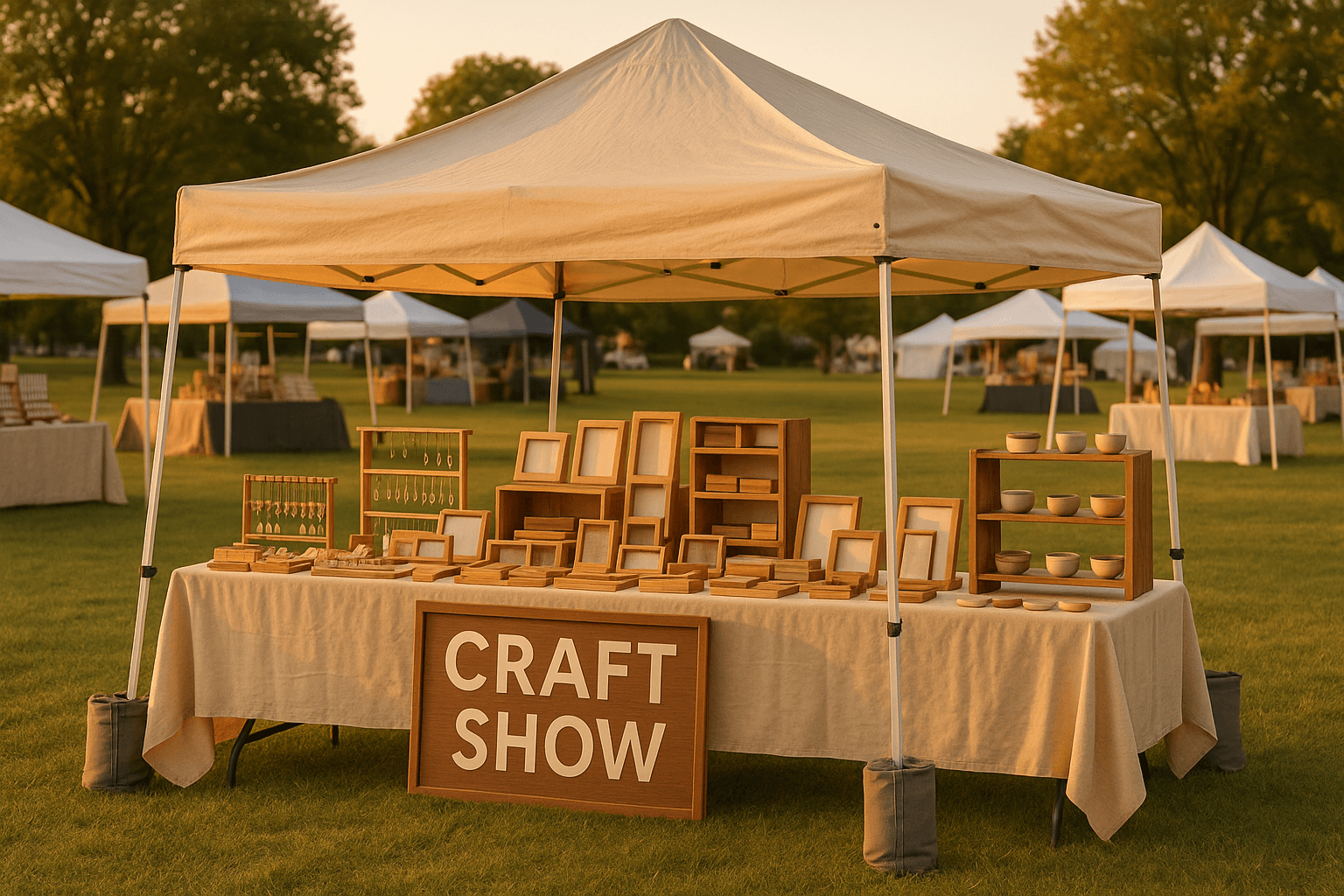
Here is a real scenario that plays out at outdoor shows every season: a vendor's display tent catches a gust of wind, breaks free from its weights, and crashes into the neighboring booth. The neighboring vendor's hand-painted originals — $3,000 worth of framed art — are destroyed. The tent also clips a customer on the way down, sending them to urgent care with a gashed forehead.
Who pays for that? Without insurance, the vendor whose tent flew away is personally on the hook. A single booth accident lawsuit can exceed $50,000 when you factor in medical bills, property damage, legal fees, and lost income claims.
General Liability vs. Product Liability
This is where most craft vendors get confused, and it matters.
General Liability
This covers bodily injury and property damage that happens at your booth. A customer trips over your extension cord. Your shelving unit falls on someone. Your tent damages another vendor's setup. General liability is what show organizers are asking for when they send you that contract.
The standard requirement across the industry is $1 million per occurrence and $2 million aggregate.
Product Liability
This covers injuries or damages caused by the products you sell after the customer takes them home. A customer has an allergic reaction to your handmade soap. A child chokes on a small component of your jewelry. A candle you made causes a house fire.
Product liability is separate from general liability, and many base policies include both. But not all of them do. If you sell consumable products (food, skincare, candles, anything someone puts on or in their body), confirm your policy explicitly includes product liability coverage.
What Is NOT Covered
Your inventory is not covered under general liability or product liability policies. If someone steals $2,000 worth of your handmade goods from your booth, or a rainstorm destroys your stock, your base vendor insurance policy will not pay for it.
Inventory and equipment protection falls under inland marine insurance or business personal property coverage, which is a separate add-on. Expect to pay an additional $100-$300 per year for this coverage.
What Does Craft Show Vendor Insurance Cost?
Per-Event Coverage (Best for 1-3 Shows per Year)
- ACT Insurance (Go Plan): ~$49 per event. Covers general liability at the $1M/$2M standard. Certificate of Insurance available immediately after purchase.
- Thimble: Starts at roughly $5 per hour or ~$39-$85 per day depending on your business type. Flexible for single-day pop-ups.
Annual Coverage (Best for 4+ Shows per Year)
- Insurance Canopy: $175-$250 per year for general liability. One of the most affordable annual options.
- ACT Insurance (Pro Plan): ~$229-$279 per year. Includes general and product liability.
- Next Insurance: Starts around $175-$250 per year. Fully online application and instant certificate generation.
Quick Comparison Table
| Provider | Type | Price | Best For |
|---|---|---|---|
| ACT Go | Per-event | ~$49/event | 1-3 shows per year |
| Thimble | Hourly/daily | ~$5/hour, ~$39-85/day | Pop-ups, short events |
| Insurance Canopy | Annual | $175-$250/year | Budget-conscious regulars |
| ACT Pro | Annual | $229-$279/year | Vendors needing product liability |
| Next Insurance | Annual | $175-$250/year | Year-round coverage |
What "Additional Insured" Means
Nearly every show contract will require you to add the event organizer as an Additional Insured on your policy. This is not optional.
Being listed as Additional Insured means that if a claim arises from your booth, the organizer is also covered under your policy. Here is how to handle it:
- Purchase your policy (annual or per-event).
- Log into your insurance provider's portal.
- Generate a Certificate of Insurance (COI).
- Add the event organizer's legal name and address as Additional Insured.
- Email or upload the COI to the event organizer by their deadline.
Most modern providers let you do this entirely online in under ten minutes. Pro tip: read the vendor contract carefully for the exact legal name they want listed.
Do You Actually Need Insurance If the Show Does Not Require It?
The honest answer: you are taking a real financial risk if you skip it.
Consider what you are bringing to a public event: physical structures, electrical equipment, products that people will touch, hold, consume, or wear. You are operating a retail business surrounded by strangers and other vendors' property.
If a customer gets hurt at your booth and you have no insurance, they sue you personally. Your personal savings, your car, potentially your home equity — all on the table.
At $49 per event or $175 per year, vendor insurance is the cheapest form of business protection available to you.
How to Get Insured: Step by Step
Step 1: Decide per-event or annual. Fewer than four shows? Go per-event. Four or more? Go annual.
Step 2: Choose a provider. For per-event, ACT Go or Thimble. For annual, Insurance Canopy, ACT Pro, or Next Insurance.
Step 3: Describe your business. What you sell, estimated annual revenue, whether you have employees. Five to ten minutes.
Step 4: Get your quote and purchase.
Step 5: Generate your COI. Add the event organizer as Additional Insured. Download the PDF.
Step 6: Submit to the organizer at least two weeks before the event.
Total time from start to finish: fifteen to thirty minutes.
What to Do If a Show Is Next Week and You Have No Insurance
Do not panic. Thimble can get you covered in minutes for a single day. ACT Go can issue per-event coverage with a same-day COI. Neither requires a lengthy application process.
Managing the Business Side of Vendor Shows
Insurance is one piece of the operational puzzle. You also need to manage orders, capture leads from booth visitors, and handle shipping for customers who do not want to carry a large purchase home from the event. If you are still tracking orders on paper, Shipyie was built specifically for convention and craft show vendors — handling order management, post-show shipping, and lead capture so you can focus on selling.
Key Takeaways
- Most shows require $1M per occurrence / $2M aggregate general liability
- Per-event insurance runs about $49/event. Annual policies cost $175-$279/year
- General liability covers booth accidents. Product liability covers harm from your products. Make sure you have both if you sell consumables
- Your inventory is not covered by standard liability policies — you need a separate add-on
- Always list the event organizer as Additional Insured
- You can get insured and have a COI in hand in under thirty minutes
- Even when a show does not require insurance, skipping it is a financial risk that is not worth the savings