
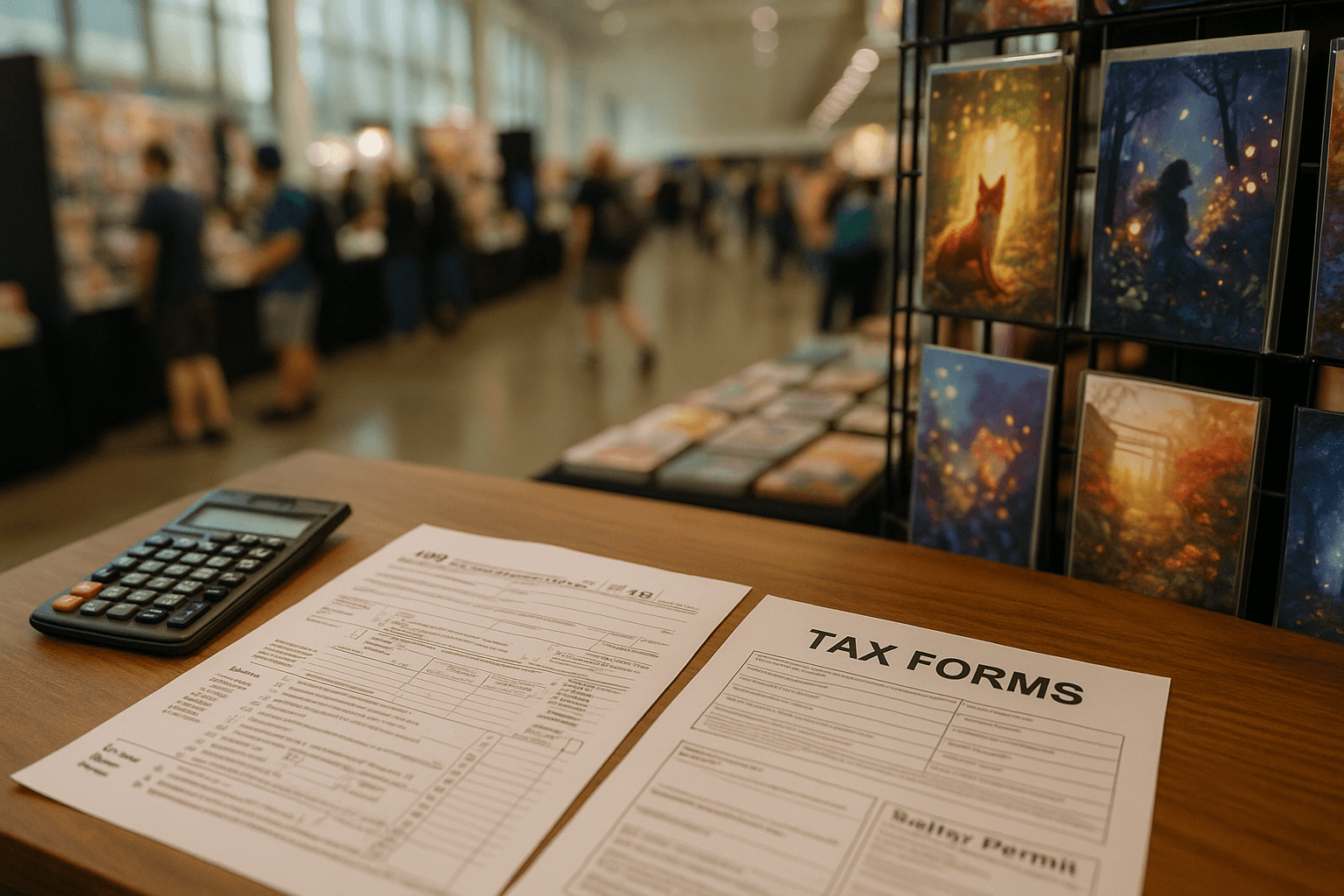
What Is Sales Tax Nexus and Why Should You Care?
You did three shows this year. One in Atlanta, one in Columbus, and one in Chicago. You packed your booth, drove the miles, sold your products, and came home with cash and card receipts. What you probably did not come home with was a clear understanding of your sales tax obligations in any of those states.
You are not alone. The majority of first-time convention vendors do not realize they need a seller's permit until they see it buried in the event registration paperwork. And by then, the show is next week and the rules are a wall of legalese.
This guide breaks it down in plain language. State by state, threshold by threshold, so you know exactly where you stand before you load the van.
Nexus is the legal connection between you and a state that gives that state the right to collect tax from you. For convention vendors, the rule is brutally simple: if you are physically present at an event and selling goods, you have created nexus in that state.
You do not need a storefront. You do not need a warehouse. You do not even need to make a sale in some states. Standing behind a booth with products on the table can be enough.
Once nexus is established, the state expects you to register for a sales tax permit, collect the correct tax rate from buyers, and remit that tax to the state on their filing schedule. Fail to do so and you are personally liable for every dollar of uncollected tax, plus penalties and interest.
The good news: many states have built exemptions and thresholds specifically for occasional sellers and event vendors. The bad news: those thresholds vary wildly.
State-by-State Thresholds for Convention Vendors
The table below covers the states vendors ask about most often. This is not exhaustive — always confirm with the state's department of revenue before your event.
| State | Registration Required? | Exemption Threshold | Key Details |
|---|---|---|---|
| California | Yes, but free temporary permit | Exempt if under 15 days/year AND under $100K | Temporary seller's permit covers 90-day periods. Apply through CDTFA. |
| Illinois | Conditional | 2 or fewer shows/year, 8 or fewer total days, under $10K combined receipts | Exceed any one condition and full registration kicks in. |
| Georgia | Conditional | 5 or fewer days/year AND under $100K net income | Both conditions must be met for exemption. |
| Ohio | Conditional | 7 or fewer instances/year AND under $25K in sales | "Instance" means each separate event. |
| Louisiana | Yes — always | No threshold. One sale triggers full obligation. | Even a single transaction requires registration. No exemptions for occasional sellers. |
| North Carolina | Yes | Physical presence at booth establishes nexus — even without a sale | Merely occupying booth space can create nexus. |
| Tennessee | Yes | Physical presence establishes nexus regardless of sales | Same as North Carolina. Presence alone is sufficient. |
| Minnesota | Yes | Counts each day or part of a day, including setup and teardown | If you arrive the day before to set up, that counts as a day of presence. |
| Michigan | Yes | Trailing nexus applies — 11 months after last presence | Once established, you must remain compliant for 11 months after your last event. |
| Mississippi | Special rule | The event organizer or promoter is legally considered the seller | Tax responsibility may fall on the promoter, not you. Confirm with the organizer. |
| Delaware | No | No sales tax | One of four states with no sales tax. |
| Montana | No | No sales tax | No registration needed. |
| New Hampshire | No | No sales tax | No registration needed. |
| Oregon | No | No sales tax | No registration needed. |
A critical note on local rates: Even within a single state, sales tax rates vary by county and city. The rate in downtown Chicago is not the same as suburban Cook County. Your POS system can handle this automatically if configured with the correct event address — but only if you set it up before the show.
The Decision Tree: Do I Need to Register?
Walk through this before every out-of-state event.
Step 1: Is the state a no-sales-tax state? If yes (Delaware, Montana, New Hampshire, Oregon) — stop here. No action needed.
Step 2: Does the state have an occasional seller exemption? Check the table above or the state's department of revenue website.
- If no exemption exists (Louisiana, North Carolina, Tennessee) — you must register. Period.
- If an exemption exists — proceed to Step 3.
Step 3: Do you fall within the exemption thresholds? Check the number of days, number of events, and dollar amount against the state's specific limits.
- If you are within all thresholds — you are likely exempt from registration. Keep records proving you qualify.
- If you exceed any single threshold — you must register and collect tax.
Step 4: Register and configure your tax collection. Apply for a temporary or standard seller's permit. Set up the correct local tax rate in your POS system. Collect tax on every taxable sale.
Step 5: File and remit. After the event, file your return with the state by the deadline. Even if you owe zero, many states require a zero-dollar filing.
The Traps That Catch Vendors Off Guard
Trailing Nexus
Michigan is the most well-known example. You do one show in Detroit and you are on the hook for 11 months of compliance after that event ends. That means filing returns — even zero-dollar returns — for nearly a year. Miss those filings and the penalties accumulate whether or not you made another sale.
Setup and Teardown Days
Minnesota counts "each day or part of a day" you are present in the state for the event. If you drive in on Thursday to set up for a Friday-Saturday show, Thursday counts. If you tear down on Sunday, that counts too. A two-day show just became a four-day presence.
Presence Without Sales
In North Carolina and Tennessee, simply having a booth at a convention — even if you do not sell a single item — can establish nexus. This matters if you are exhibiting for brand awareness or lead generation rather than direct sales.
Mississippi's Promoter Rule
Mississippi treats the event organizer or promoter as the legal seller. This can shift tax collection responsibility away from you and onto the organizer. But "can" is doing heavy lifting in that sentence. Confirm the arrangement with the promoter in writing before the event. Do not assume.
Practical Action Steps for Multi-State Vendors
1. Build a show calendar with tax columns. For every event, record the state, number of days (including setup and teardown), and whether the state requires registration. Do this at the start of the season, not after.
2. Apply for permits early. Some states process temporary seller's permits in days. Others take weeks. California's free temporary permit is straightforward, but do not wait until the week of the show.
3. Configure your POS for each event location. Whether you use Square, Clover, or another system, update the tax rate to match the specific city and county of your event venue. Most POS platforms can auto-calculate local rates if you enter the correct address — but only if you enable the setting before the show.
4. Keep records for every state. Save receipts, sales totals, and permit copies for each event in each state. If you are audited, the burden of proof that you fell within an exemption threshold is on you.
5. File on time, even when you owe nothing. Many states require a return for every filing period once you are registered, regardless of whether you made sales. A zero-dollar return takes five minutes. A late-filing penalty does not care that you owed nothing.
6. Consult a CPA if you sell in three or more states. Multi-state sales tax compliance gets complicated fast. A CPA experienced in multi-state sales tax typically charges $200–$500+ for a consultation, but one session can save you thousands in penalties and back taxes. This is especially worthwhile if you are doing the circuit — 10 or more events per year across state lines.
A Word on Automation
Modern POS systems can auto-charge the correct local tax rate when configured with the event's address. This removes the mental math but does not remove the obligation to register, file, and remit. Technology handles the collection. You handle the compliance.
Disclaimer
This article is for informational purposes only and does not constitute legal or tax advice. Sales tax laws change frequently, and state-specific rules may have been updated after publication. Always consult a qualified tax professional or your state's department of revenue for guidance specific to your situation.